


God's Command
Published on 29. October 2015
Book
Hardback
350 pages
978-0-19-960201-8 (ISBN)
Description
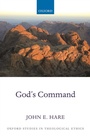
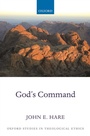
This work focuses on divine command, and in particular the theory that what makes something obligatory is that God commands it, and what makes something wrong is that God commands us not to do it. Focusing on the Abrahamic faiths, eminent scholar John E. Hare explains that two experiences have had to be integrated. The first is that God tells us to do something, or not to do something. The second is that we have to work out ourselves what to do and what not to do. The difficulty has come in establishing the proper relation between them. In Christian reflection on this, two main traditions have emerged, divine command theory and natural law theory.
Professor Hare successfully defends a version of divine command theory, but also shows that there is considerable overlap with some versions of natural law theory. He engages with a number of Christian theologians, particularly Karl Barth, and extends into a discussion of divine command within Judaism and Islam. The work concludes by examining recent work in evolutionary psychology, and argues that thinking of our moral obligations as produced by divine command offers us some help in seeing how a moral conscience could develop in a way that is evolutionarily stable.
Professor Hare successfully defends a version of divine command theory, but also shows that there is considerable overlap with some versions of natural law theory. He engages with a number of Christian theologians, particularly Karl Barth, and extends into a discussion of divine command within Judaism and Islam. The work concludes by examining recent work in evolutionary psychology, and argues that thinking of our moral obligations as produced by divine command offers us some help in seeing how a moral conscience could develop in a way that is evolutionarily stable.
Reviews / Votes
The book is incredibly rich in scope and ambition, canvassing just about every major philosophical issue that arises in connection with divine commands. In the process Hare discusses a dizzying array of thinkers who have reflected on relevant issues, critiquing many of them with insights both trenchant and penetrating. The net effect is an impressive and comprehensive articulation and defense of divine command theory. * David Baggett, Liberty University * God's Command is an outstanding defence of a version of divine command theory. ... the book is a major contribution to the discussions of divine command in both philosophical and theological ethics. * Mustafa Cakmak, Studies in Christian Ethics *More details
Other editions
Additional editions
Person
John E. Hare received his BA from Oxford University, and his Ph.D. from Princeton University. He then taught at
Lehigh University, with a couple of years on the staff of the House Foreign Affairs Committee in Washington, DC.
He then taught at Calvin College, and went to Yale in 2003, where he teaches in the Divinity School, the
Philosophy Department, the Religious Studies Department, and the Classics Department. He has written six
books, including The Moral Gap (OUP 1997) and God and Morality (Wiley-Blackwell 2009).
Lehigh University, with a couple of years on the staff of the House Foreign Affairs Committee in Washington, DC.
He then taught at Calvin College, and went to Yale in 2003, where he teaches in the Divinity School, the
Philosophy Department, the Religious Studies Department, and the Classics Department. He has written six
books, including The Moral Gap (OUP 1997) and God and Morality (Wiley-Blackwell 2009).
Content
Preface ; 1. Morality and Religion ; 2. What is a Divine Command? ; 3. Eudaimonism ; 4. Can We Deduce Morality from Human Nature? ; 5. Barth on Divine Command ; 6. Divine Command in Some Medieval Islamic Thinkers ; 7. Divine Command in Some Recent Jewish Thinkers ; 8. Divine Command and Evolutionary Psychology ; 9. Summary ; Bibliography