

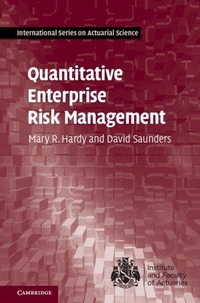
Quantitative Enterprise Risk Management
Published on 5. May 2022
Book
Hardback
698 pages
978-1-009-09846-5 (ISBN)
Description
This well-balanced introduction to enterprise risk management integrates quantitative and qualitative approaches and motivates key mathematical and statistical methods with abundant real-world cases - both successes and failures. Worked examples and end-of-chapter exercises support readers in consolidating what they learn. The mathematical level, which is suitable for graduate and senior undergraduate students in quantitative programs, is pitched to give readers a solid understanding of the concepts and principles involved, without diving too deeply into more complex theory. To reveal the connections between different topics, and their relevance to the real world, the presentation has a coherent narrative flow, from risk governance, through risk identification, risk modelling, and risk mitigation, capped off with holistic topics - regulation, behavioural biases, and crisis management - that influence the whole structure of ERM. The result is a text and reference that is ideal for graduate and senior undergraduate students, risk managers in industry, and anyone preparing for ERM actuarial exams.
Reviews / Votes
'Quantitative Enterprise Risk Management can be strongly recommended to anyone seeking to develop their skills in risk management. The book will be particularly useful for those seeking to master the more challenging technical aspects of risk management missing in other textbooks.' Andrew Cairns, Heriot-Watt University 'This hits the sweet spot between overly abstract mathematical and overly 'math lean' presentations of enterprise risk management.' Gary Hatfield, University of Minnesota 'Hardy and Saunders have written a masterpiece that not only explains [ERM] from a quantitative perspective, but also manages to bridge the gap between it and more qualitative approaches. It impressively covers the whole spectrum from risk taxonomy, risk modelling and measurement, risk mitigation, risk transfer up to (behavioural) risk, and crisis management. I highly recommend it to all those who want to get a deeper understanding of ERM.' Rudi Zagst, Technical University of MunichMore details
Series
Language
English
Place of publication
Cambridge
United Kingdom
Illustrations
Worked examples or Exercises
Dimensions
Height: 235 mm
Width: 157 mm
Thickness: 41 mm
Weight
1131 gr
ISBN-13
978-1-009-09846-5 (9781009098465)
Copyright in bibliographic data and cover images is held by Nielsen Book Services Limited or by the publishers or by their respective licensors: all rights reserved.
Schweitzer Classification
Persons
Mary R. Hardy is Professor in the Department of Statistics and Actuarial Science at the University of Waterloo. She is a past Vice President of the Society of Actuaries, and was initiated as a Chartered Enterprise Risk Analyst through the Thought Leadership program. She has a PhD in Actuarial Science from Heriot-Watt University, and is a Fellow of the Society of Actuaries, and of the Institute and Faculty of Actuaries, which awarded her the prestigious Finlaison Medal for service to the profession in 2012. Her past books include Actuarial Mathematics for Life Contingent Risks and Investment Guarantees: Modelling and Risk Management.
Content
Preface; 1. Introduction to enterprise risk management; 2. Risk taxonomy; 3. Risk measures; 4. Frequency-Severity analysis; 5. Extreme value theory; 6. Copulas; 7. Stress testing; 8. Market risk models; 9. Short term portfolio risk; 10. Economic scenario generators; 11. Interest rate risk; 12. Credit risk; 13. Liquidity risk; 14. Model risk and governance; 15. Risk mitigation using options and derivatives; 16. Risk transfer; 17. Regulation of financial institutions; 18. Risk adjusted measures of profit and capital allocation; 19. Behavioural risk management; 20. Crisis management; A. Probability and statistics review; References; Index.