

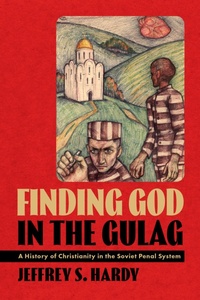
Finding God in the Gulag
A History of Christianity in the Soviet Penal System
Published on 19. December 2024
Book
Hardback
280 pages
978-0-19-775167-1 (ISBN)
Description
A core tenet of the Soviet Communist Party's ideology was the belief that religion was an oppressive tool, wielded by the exploiting classes. With help of the secret police, they attempted to eliminate it completely from Soviet society by, in part, imprisoning believers and attempting to "re-educate" them in the labor camps of the infamous Gulag. However, the aims of the Gulag were conflicted, and anti-religious activities were rarely prioritized. In their absence, religious practices became important to inmates and played integral roles in their lives. Imprisoned Christians found ways to pray, read scripture, sing hymns, celebrate Easter, and commune with their fellow believers.
Finding God in the Gulag tells the story of how these inmates saw their suffering as part of God's will or as a sign of the coming Apocalypse. The struggle between good and evil felt real to many, although for some, the dire struggle to survive the brutalizing world of Soviet labor camps prompted doubt, despair, and ultimately the abandonment of their beliefs. Many were also converted in the camps through the proselytizing efforts of fellow prisoners, finding in Christianity a source of hope, comfort, and community.
This tension between atheism, faith, repression, doubt, and conversion endured throughout the Soviet Union's existence. Remarkably, in the last years of Soviet power, Christianity flourished in the remnants of the Gulag system and was even used by guards as a method of re-educating their inmates.
Finding God in the Gulag tells the story of how these inmates saw their suffering as part of God's will or as a sign of the coming Apocalypse. The struggle between good and evil felt real to many, although for some, the dire struggle to survive the brutalizing world of Soviet labor camps prompted doubt, despair, and ultimately the abandonment of their beliefs. Many were also converted in the camps through the proselytizing efforts of fellow prisoners, finding in Christianity a source of hope, comfort, and community.
This tension between atheism, faith, repression, doubt, and conversion endured throughout the Soviet Union's existence. Remarkably, in the last years of Soviet power, Christianity flourished in the remnants of the Gulag system and was even used by guards as a method of re-educating their inmates.
More details
Language
English
Place of publication
New York
United States
Product notice
sewn/stitched
Cloth over boards
Illustrations
16 b/w
Dimensions
Height: 240 mm
Width: 166 mm
Thickness: 27 mm
Weight
525 gr
ISBN-13
978-0-19-775167-1 (9780197751671)
Copyright in bibliographic data and cover images is held by Nielsen Book Services Limited or by the publishers or by their respective licensors: all rights reserved.
Schweitzer Classification
Other editions
Additional editions
E-Book
10/2024
OUP eBook
€28.49
Available for download
E-Book
10/2024
OUP eBook
€28.49
Available for download
Person
Jeffrey S. Hardy is Associate Professor of History at Brigham Young University. He is the author of The Gulag After Stalin: Redefining Punishment in the Post-Stalin Soviet Union, 1953-1964 and The Soviet Gulag: History and Memory.
Content
Preface
Introduction
Section I: The Early Soviet Era, 1917-1929
1. Separating Church and State in Bolshevik Prisons
2. The Spiritual Life of Solovki
Section II: The Stalin Era, 1929-1953
3. The War against Religion in the Gulag
4. Belief and Disbelief from the Great Terror to Stalin's Death
5. Western Worshippers and Gulag Gangsters
Section III: The Post-Stalin Era, 1953-1991
6. Khrushchev's Reforms and the Camp for Sectarians
7. Religious Dissidents under Brezhnev
8. Christianity as a Re-educational Program
Epilogue
Bibliography
Index
Introduction
Section I: The Early Soviet Era, 1917-1929
1. Separating Church and State in Bolshevik Prisons
2. The Spiritual Life of Solovki
Section II: The Stalin Era, 1929-1953
3. The War against Religion in the Gulag
4. Belief and Disbelief from the Great Terror to Stalin's Death
5. Western Worshippers and Gulag Gangsters
Section III: The Post-Stalin Era, 1953-1991
6. Khrushchev's Reforms and the Camp for Sectarians
7. Religious Dissidents under Brezhnev
8. Christianity as a Re-educational Program
Epilogue
Bibliography
Index