

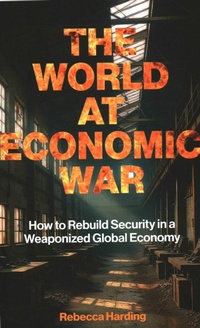
The World at Economic War
How to Rebuild Security in a Weaponized Global Economy
Published on 16. September 2025
Book
Paperback/Softback
176 pages
978-1-916749-45-0 (ISBN)
Description
The World at Economic War is a timely and thought-provoking
reminder of the role that economics plays in modern warfare. It argues that
economics itself is at war - the institutions of the post-war economic order
are riven with challenges to their legitimacy, rendering the old certainties of
market-based economics at best contested and at worst irrelevant. It shows how,
through the interdependencies of globalization, the market system itself has
become a means of 'great power conflict', accelerated by the rapid pace of
financial services digitalization. This economic conflict seeps into the way
international trade operates, into the way cross-border payments are made, into
supply chains, and even into how financial markets control the capacity of
governments to manage macroeconomic policy.
The institutions that were constructed to deal with a
peacetime economy are no longer adequate against a backdrop of military
conflict in Europe and the Middle East and heightened tensions in the Asia
Pacific region. Spending on defence and security seemed unimportant against a
backdrop of globalization, but because the world is now at economic war, there
is limited capacity either to build capacity or to fund our defence and
security. Military and economic security are two sides of the same coin: both are
a means of power projection; both are deeply political; and both are our means
of deterrence, defence, coercion and resilience.
reminder of the role that economics plays in modern warfare. It argues that
economics itself is at war - the institutions of the post-war economic order
are riven with challenges to their legitimacy, rendering the old certainties of
market-based economics at best contested and at worst irrelevant. It shows how,
through the interdependencies of globalization, the market system itself has
become a means of 'great power conflict', accelerated by the rapid pace of
financial services digitalization. This economic conflict seeps into the way
international trade operates, into the way cross-border payments are made, into
supply chains, and even into how financial markets control the capacity of
governments to manage macroeconomic policy.
The institutions that were constructed to deal with a
peacetime economy are no longer adequate against a backdrop of military
conflict in Europe and the Middle East and heightened tensions in the Asia
Pacific region. Spending on defence and security seemed unimportant against a
backdrop of globalization, but because the world is now at economic war, there
is limited capacity either to build capacity or to fund our defence and
security. Military and economic security are two sides of the same coin: both are
a means of power projection; both are deeply political; and both are our means
of deterrence, defence, coercion and resilience.
Reviews / Votes
"We have a strong tendency to separateelements of national security into manage-able bits in order to fit our
existing structures or our preconceived view of the world. In this important
book, Rebecca Harding demonstrates that everything is linked to geopolitics,
supply chain disruption and frictions caused by crumbling or failing infrastructure.
Rebecca Harding has placed economic security at the heart of defence and
security thinking, where it needs to be. She calls out the failings in defence
finance, provides a comprehensive analysis of how supply chains are being
disrupted, and argues that we need to move from economic statecraft to a focus
on economic security if we are to resolve all of these existential issues.
Passive to active, this is not a call for more discussion, it is a call to
action. I commend it."
- Air Chief Marshal The Lord
Peach KG GBE KCB DL
"The World at Economic War is
a tour de force of the threats that we face to our civil society through
frequent and pervasive attacks on our economic infrastructures. It is a study
in the realpolitik of our current era and provides a pragmatic and surprisingly
upbeat solution by reorienting our thinking around economic security. This is a
must read for economists, business leaders and policy makers alike."
- Paul Mason, author of How To
Stop Fascism and columnist at The New World
"The World at Economic War is
obligatory reading for all those who need to under-stand the role that
economics plays in modern warfare. Rebecca Harding does not pull her punches.
From a starting point that many political leaders still find painful to
acknowledge - that the era of the international rules-based order is over - she
takes the reader on a journey through the inadequacies of our current
institutional struc-tures, which are legacies of that era, created to deal with
the then threats to Nato allies and now in urgent need of transformation. In so
doing, she lays bare the most pressing challenge of the new age in its starkest
possible terms. Her forensic exam-ination of the problem makes a major
contribution not just to the debate about the need for drastic change, but also
to identifying potential solutions."
- Chris Donnelly, Principal
Counsellor, Earendel Associates Ltd
More details
Series
Language
English
Place of publication
London
United Kingdom
Dimensions
Height: 214 mm
Width: 134 mm
Thickness: 13 mm
Weight
274 gr
ISBN-13
978-1-916749-45-0 (9781916749450)
Copyright in bibliographic data and cover images is held by Nielsen Book Services Limited or by the publishers or by their respective licensors: all rights reserved.
Schweitzer Classification
Other editions
Additional editions
E-Book
09/2025
London Publishing Partnership
€14.49
Available for download
Person
Dr Rebecca Harding is CEO of the
Centre for Economic Security and an independent trade economist, author and
public speaker. Her strategic advisory business, Rebeccanomics, provides
analytical services in international trade, trade finance and sustainability.
She has held positions as a senior fellow at the British Foreign Policy Group,
as head of corporate research at Deloitte, as a senior fellow at London
Business School, and as chief economist at the Work Foundation and at UK
Finance. She acted as a specialist adviser to the Treasury Select Committee and
has advised the All-Party Parliamentary Group on Entrepreneurship.
Centre for Economic Security and an independent trade economist, author and
public speaker. Her strategic advisory business, Rebeccanomics, provides
analytical services in international trade, trade finance and sustainability.
She has held positions as a senior fellow at the British Foreign Policy Group,
as head of corporate research at Deloitte, as a senior fellow at London
Business School, and as chief economist at the Work Foundation and at UK
Finance. She acted as a specialist adviser to the Treasury Select Committee and
has advised the All-Party Parliamentary Group on Entrepreneurship.
Content
Preface
CHAPTER 1
Are we at economic war, and what is it?
CHAPTER 2
Why are we at economic war?
CHAPTER 3
The unforeseen consequences of economic statecraft
CHAPTER 4
Institutional and systemic economic war
CHAPTER 5
How to fight economic war
CHAPTER 6
How to identify economic security threats
CHAPTER 7
How to wargame economic war
CHAPTER 8
Building economic security
Notes
CHAPTER 1
Are we at economic war, and what is it?
CHAPTER 2
Why are we at economic war?
CHAPTER 3
The unforeseen consequences of economic statecraft
CHAPTER 4
Institutional and systemic economic war
CHAPTER 5
How to fight economic war
CHAPTER 6
How to identify economic security threats
CHAPTER 7
How to wargame economic war
CHAPTER 8
Building economic security
Notes