

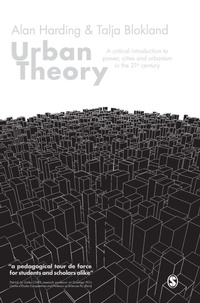
Urban Theory
A critical introduction to power, cities and urbanism in the 21st century
1st Edition
Published on 16. May 2014
Book
Hardback
312 pages
978-1-4462-9451-2 (ISBN)
Description
What is Urban Theory? How can it be used to understand our urban experiences? Experiences typically defined by enormous inequalities, not just between cities but within cities, in an increasingly interconnected and globalised world. This book explains:
Relations between urban theory and modernity in key ideas of the Chicago School, spatial analysis, humanistic urban geography, and 'radical' approaches like Marxism
Cities and the transition to informational economies, globalization, urban growth machine and urban regime theory, the city as an "actor"
Spatial expressions of inequality and key ideas like segregation, ghettoization, suburbanization, gentrification
Socio-cultural spatial expressions of difference and key concepts like gender, sexuality, race, ethnicity and "culturalist" perspectives on identity, lifestyle, subculture
How cities should be understood as intersections of horizontal and vertical - of coinciding resources, positions, locations, influencing how we make and understand urban experiences.
Critical, interdisciplinary and pedagogically informed - with opening summaries, boxes, questions for discussion and guided further reading - Urban Theory: A Critical Introduction to Power, Cities and Urbanism in the 21st Century provides the tools for any student of the city to understand, even to change, our own urban experiences.
Relations between urban theory and modernity in key ideas of the Chicago School, spatial analysis, humanistic urban geography, and 'radical' approaches like Marxism
Cities and the transition to informational economies, globalization, urban growth machine and urban regime theory, the city as an "actor"
Spatial expressions of inequality and key ideas like segregation, ghettoization, suburbanization, gentrification
Socio-cultural spatial expressions of difference and key concepts like gender, sexuality, race, ethnicity and "culturalist" perspectives on identity, lifestyle, subculture
How cities should be understood as intersections of horizontal and vertical - of coinciding resources, positions, locations, influencing how we make and understand urban experiences.
Critical, interdisciplinary and pedagogically informed - with opening summaries, boxes, questions for discussion and guided further reading - Urban Theory: A Critical Introduction to Power, Cities and Urbanism in the 21st Century provides the tools for any student of the city to understand, even to change, our own urban experiences.
Reviews / Votes
Just when we need it most, urban theory seems to be failing us. This book explains why we need it. -- Jamie Peck Harding and Blokland address the vaunted "crisis" in urban theory with a thoughtful assessment of extant theories in terms of performance, commensurability, and critical engagement. In a conversational and lively tone, they view theories of inequality, public space, identity, power, agency, and culture through the lens of "relaxed urban theory." Excellent overview for scholars and engaging classroom material. -- Susan E. Clarke Inspired by Peter Saunders's non-spatial urban thinking, Harding and Blokland's book provides a provocative, wide-ranging and comprehensive treatment of concepts geared to understand cities, and is a compulsory addition to any urban student's intellectual arsenal in a period of renewed interest in urban theory. -- Roger Keil Urban theory is said to be in a mess. Proceeding with great analytical clarity, this book introduces a relaxed definition of urban theory that enables the reader to make sense of the non-linear, variegated world of urban theory as it has developed over time and through the application of different disciplines, methods and epistemologies. In reviewing all the major conceptualisations of urban theory, Harding and Blokland provide clear insights into recent developments and the controversies and critiques they have provoked. The book is a pedagogical tour de force for students and scholars alike. -- Patrick Le GalesMore details
Language
English
Place of publication
London
United Kingdom
Target group
College/higher education
Dimensions
Height: 250 mm
Width: 175 mm
Thickness: 21 mm
Weight
724 gr
ISBN-13
978-1-4462-9451-2 (9781446294512)
Copyright in bibliographic data and cover images is held by Nielsen Book Services Limited or by the publishers or by their respective licensors: all rights reserved.
Schweitzer Classification
Other editions
Additional editions
Alan Harding | Talja Blokland
Urban Theory
A critical introduction to power, cities and urbanism in the 21st century
Book
05/2014
1st Edition
SAGE Publications Ltd
€87.50
Shipment within 15-20 days
Alan Harding | Talja Blokland
Urban Theory
A critical introduction to power, cities and urbanism in the 21st century
E-Book
05/2014
1st Edition
SAGE Publications Ltd
€69.39
Available for download
Persons
Alan Harding is Professor of Public Policy and Director of the Heseltine Institute for Public Policy and Practice at the University of Liverpool Management School in the UK. Previously, he held posts at Manchester, Salford and Liverpool John Moores universities. His research interests are in urban and regional development, governance and policy and he has acted as an advisor on these issues for a wide range of leading agencies with interests in this field.
Talja Blokland (1971) is an urban sociologist who has worked at Yale University, the University of Manchester and various Dutch universities. Since 2009, she has held the chair of Urban and Regional Sociology at Humboldt University in Berlin. Her publications include Urban Bonds (Polity 2003), Networked Urbanism (edited with Mike Savage, Ashgate 2008) and various articles on race and ethnicity in the city, poor neighbourhoods, urban violence, gentrification, urban middle classes and neighbourhood relations and everyday interactions.
Talja Blokland (1971) is an urban sociologist who has worked at Yale University, the University of Manchester and various Dutch universities. Since 2009, she has held the chair of Urban and Regional Sociology at Humboldt University in Berlin. Her publications include Urban Bonds (Polity 2003), Networked Urbanism (edited with Mike Savage, Ashgate 2008) and various articles on race and ethnicity in the city, poor neighbourhoods, urban violence, gentrification, urban middle classes and neighbourhood relations and everyday interactions.
Content
1. WHAT IS URBAN THEORY?
Urban Studies and Urban Theory
What is Urban?
What is Theory?
And So What on Earth is Urban Theory?
2. URBAN THEORIES UNDER CONDITIONS OF MODERNITY
The Chicago School and Urban Ecology
Urban Geography and Spatial Analysis
The Community Power Debate
Humanistic (Urban) Geography
'Radical' Approaches
The Legacy of Previous Theories and Their Challenges
3. FROM THE URBAN CRISIS TO THE 'TRIUMPH OF THE CITY'
Cities as Actors in a Globalising Economy
Urban Decline and Obsolescence
Urban Economic Renaissance
Discussion
4. CAN CITIES ACT? URBAN POLITICAL ECONOMY AND THE QUESTION OF AGENCY
The Rediscovery of Agency Within Urban Theory
Introducing American Urban Political Economy
Urban Regimes and Growth Machines
The Normative Dimension
Critiques and Applications
5. SPATIAL EXPRESSIONS OF INTRA-URBAN INEQUALITIES
Inequalities Versus Differentiations: Vertical and Horizontal Paradigms
Cities as Sites of Resources: Space and Inequalities
Segregation
Suburbanization
Gentrification
Ghettoization as a Spatial Process of Marginalization
Neighbourhood Effects: Spatial Profit and Disadvantage
6. SPATIAL EXPRESSION OF DIFFERENTIATION
The Cultural Turn
The City as a Realm of Community and Lifestyle
The Subcultural Thesis
The Representational City: Public Space
Cultural Diversity: Identities in Public Space
Conclusion: Cities as Matrix of Resources
7. URBAN THEORY RECONSIDERED
The 'Crisis' in Urban Theory Revisited
The Performance of Theories
The Commensurability of Theories
Theory, Politics and Practice
A New Urban Agenda?
Urban Studies and Urban Theory
What is Urban?
What is Theory?
And So What on Earth is Urban Theory?
2. URBAN THEORIES UNDER CONDITIONS OF MODERNITY
The Chicago School and Urban Ecology
Urban Geography and Spatial Analysis
The Community Power Debate
Humanistic (Urban) Geography
'Radical' Approaches
The Legacy of Previous Theories and Their Challenges
3. FROM THE URBAN CRISIS TO THE 'TRIUMPH OF THE CITY'
Cities as Actors in a Globalising Economy
Urban Decline and Obsolescence
Urban Economic Renaissance
Discussion
4. CAN CITIES ACT? URBAN POLITICAL ECONOMY AND THE QUESTION OF AGENCY
The Rediscovery of Agency Within Urban Theory
Introducing American Urban Political Economy
Urban Regimes and Growth Machines
The Normative Dimension
Critiques and Applications
5. SPATIAL EXPRESSIONS OF INTRA-URBAN INEQUALITIES
Inequalities Versus Differentiations: Vertical and Horizontal Paradigms
Cities as Sites of Resources: Space and Inequalities
Segregation
Suburbanization
Gentrification
Ghettoization as a Spatial Process of Marginalization
Neighbourhood Effects: Spatial Profit and Disadvantage
6. SPATIAL EXPRESSION OF DIFFERENTIATION
The Cultural Turn
The City as a Realm of Community and Lifestyle
The Subcultural Thesis
The Representational City: Public Space
Cultural Diversity: Identities in Public Space
Conclusion: Cities as Matrix of Resources
7. URBAN THEORY RECONSIDERED
The 'Crisis' in Urban Theory Revisited
The Performance of Theories
The Commensurability of Theories
Theory, Politics and Practice
A New Urban Agenda?