

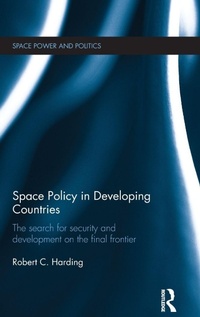
Space Policy in Developing Countries
The Search for Security and Development on the Final Frontier
1st Edition
Published on 7. June 2012
Book
Hardback
248 pages
978-0-415-53845-9 (ISBN)
Description
This book analyses the rationale and history of space programs in countries of the developing world.
Space was at one time the sole domain of the wealthiest developed countries. However, the last couple of decades of the twentieth century and the first decade of the twenty-first century have witnessed the number of countries with state-supported space programs blossom. Today, no less than twenty-five developing states, including the rapidly emerging economic powers of Brazil (seventh-largest), China (second-largest), and India (fourth-largest), possess active national space programs with already proven independent launch capability or concrete plans to achieve it soon.
This work places these programs within the context of international relations theory and foreign policy analysis. The author categorizes each space program into tiers of development based not only on the level of technology utilised, but on how each fits within the country's overall national security and/or development policies. The text also places these programs into an historical context, which enables the author to demonstrate the logical thread of continuity in the political rationale for space capabilities generally.
This book will be of much interest to students of space power and politics, development studies, strategic studies and international relations in general.
Space was at one time the sole domain of the wealthiest developed countries. However, the last couple of decades of the twentieth century and the first decade of the twenty-first century have witnessed the number of countries with state-supported space programs blossom. Today, no less than twenty-five developing states, including the rapidly emerging economic powers of Brazil (seventh-largest), China (second-largest), and India (fourth-largest), possess active national space programs with already proven independent launch capability or concrete plans to achieve it soon.
This work places these programs within the context of international relations theory and foreign policy analysis. The author categorizes each space program into tiers of development based not only on the level of technology utilised, but on how each fits within the country's overall national security and/or development policies. The text also places these programs into an historical context, which enables the author to demonstrate the logical thread of continuity in the political rationale for space capabilities generally.
This book will be of much interest to students of space power and politics, development studies, strategic studies and international relations in general.
More details
Series
Language
English
Place of publication
London
United Kingdom
Publishing group
Taylor & Francis Ltd
Target group
College/higher education
Professional and scholarly
Illustrations
8 s/w Tabellen
8 Tables, black and white
Dimensions
Height: 240 mm
Width: 161 mm
Thickness: 18 mm
Weight
543 gr
ISBN-13
978-0-415-53845-9 (9780415538459)
Copyright in bibliographic data and cover images is held by Nielsen Book Services Limited or by the publishers or by their respective licensors: all rights reserved.
Schweitzer Classification
Other editions
Additional editions
Robert Harding
Space Policy in Developing Countries
The Search for Security and Development on the Final Frontier
Book
01/2017
1st Edition
Routledge
€83.60
Shipment within 10-20 days
Robert Harding
Space Policy in Developing Countries
The Search for Security and Development on the Final Frontier
E-Book
09/2012
1st Edition
Routledge
€77.99
Available for download
Robert Harding
Space Policy in Developing Countries
The Search for Security and Development on the Final Frontier
E-Book
09/2012
1st Edition
Routledge
€77.99
Available for download
Person
Robert C. Harding is Associate Professor, Department of Political Science, at Valdosta University, GA, USA. His principal research interests are space policy, international security, and Latin American politics. He is the author of Military Foundations of Panamanian Politics (2001), The History of Panama (2006), and many scholarly articles in a number of refereed journals, including Air & Space Power Journal.
Content
Preface. Introduction: Space Power as National Power 1. Space Power and the Modern State 2. The Evolution of National Space Policies 3. First Tier Space Powers (Launching BRICs into Space) 4. Second Tier Space Powers 5. Third Tier Space Powers. Conclusions: Space Policy in Developing Countries