

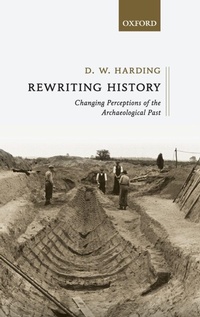
Rewriting History
Changing Perceptions of the Past
Published on 13. January 2020
Book
Hardback
312 pages
978-0-19-881773-4 (ISBN)
Description
In Rewriting History, Dennis Harding addresses contemporary concerns about information and its interpretation. His focus is on the archaeology of prehistoric and early historic Britain, and the transformation over two centuries and more in the interpretation of the archaeological heritage by changes in the prevailing political, social, and intellectual climate. Far from being topics of concern only to academics, the way in which seemingly innocuous issues such as cultural diffusion or social reconstruction in the remote past are studied and presented reflects important shifts in contemporary thinking that challenge long-accepted conventions of free speech and debate.
Some issues are highly controversial, such as the proposals for the Stonehenge World Heritage sites. Others challenge long-held popular myths like the deconstruction of the Celts, and by extension the Picts. Some traditional tenets of scholarship have yet remained unchallenged, such as the classical definition of civilization itself.
Why should it matter? Are the shifting attitudes of successive generations not symptomatic of healthy and vibrant debate? Are there grounds for believing that current changes are of a more disquieting character, denying the basic assumptions of rational argument and freedom of enquiry that have been the foundation of western scholarship since the Enlightenment? Re-writing History offers Harding's personal evaluation of these issues, which will resonate not only with practitioners and academics of archaeology, but across a wide range of disciplines facing similar concerns.
Some issues are highly controversial, such as the proposals for the Stonehenge World Heritage sites. Others challenge long-held popular myths like the deconstruction of the Celts, and by extension the Picts. Some traditional tenets of scholarship have yet remained unchallenged, such as the classical definition of civilization itself.
Why should it matter? Are the shifting attitudes of successive generations not symptomatic of healthy and vibrant debate? Are there grounds for believing that current changes are of a more disquieting character, denying the basic assumptions of rational argument and freedom of enquiry that have been the foundation of western scholarship since the Enlightenment? Re-writing History offers Harding's personal evaluation of these issues, which will resonate not only with practitioners and academics of archaeology, but across a wide range of disciplines facing similar concerns.
Reviews / Votes
Harding is clearly someone who loves archaeology and who cherishes its possibilities for helping people to understand more about human history. Significantly, Harding is no simple empiricist banging the epistemological drum of claims for value-free knowledge and the need to disentangle fact from theory comprehensively... Re-writing History is an interesting and provocative book that challenges the current consensus, and is all the more valuable for it. * Tim Murray, La Trobe University, Antiquity * Every archaeologist should read it in order to understand the degree to which contemporary issues, social and political attitudes and intellectual fashions have coloured our interpretations of archaeological evidence. * Christopher Catling, Current Archaeology *More details
Language
English
Place of publication
Oxford
United Kingdom
Target group
Professional and scholarly
Dimensions
Height: 240 mm
Width: 161 mm
Thickness: 21 mm
Weight
634 gr
ISBN-13
978-0-19-881773-4 (9780198817734)
Copyright in bibliographic data and cover images is held by Nielsen Book Services Limited or by the publishers or by their respective licensors: all rights reserved.
Schweitzer Classification
Other editions
Additional editions
E-Book
01/2020
1st Edition
OUP eBook
€71.99
Available for download
E-Book
01/2020
1st Edition
OUP eBook
€71.99
Available for download
Person
Dennis Harding graduated from Keble College, Oxford in English Language and Literature before gaining his D. Phil under the supervision of Professor Christopher Hawkes. He was temporary Assistant Keeper in the Ashmolean Museum before being appointed lecturer in Archaeology at Durham University in 1966. He was Abercromby Professor of Prehistoric Archaeology at Edinburgh University (1977-2007), serving as Dean of Arts (1983-6) and Vice-Principal of the University (1988-91). He has excavated later prehistoric sites from Wessex to the Western Isles, and has a particular interest in aerial archaeology, holding a current pilot's license for nearly thirty years.
Content
1: Defining the Agenda
2: Changing Interpretative Models in Archaeology
3: Recovery, Recording and Publication
4: Public Archaeology
5: Treasure Hunting and Antiquities Law
6: Mobility in Prehistory and Early Historic Times
7: Warfare and Violence
8: Hierarchical or Egalitarian
9: Stonehenge and Avebury: A Ritual and Ceremonial Landscape
10: The Celtic Debate: History, Linguistics, and Archaeology
11: Romanization: Civilization and Post-Imperialism
12: The Picts: Fact and Fantasy
13: Re-writing history, from the Age of Romanticism to the Age of Self-Interest and Misinformation
2: Changing Interpretative Models in Archaeology
3: Recovery, Recording and Publication
4: Public Archaeology
5: Treasure Hunting and Antiquities Law
6: Mobility in Prehistory and Early Historic Times
7: Warfare and Violence
8: Hierarchical or Egalitarian
9: Stonehenge and Avebury: A Ritual and Ceremonial Landscape
10: The Celtic Debate: History, Linguistics, and Archaeology
11: Romanization: Civilization and Post-Imperialism
12: The Picts: Fact and Fantasy
13: Re-writing history, from the Age of Romanticism to the Age of Self-Interest and Misinformation