

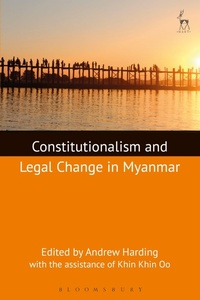
Constitutionalism and Legal Change in Myanmar
Published on 26. January 2017
Book
Hardback
312 pages
978-1-84946-790-2 (ISBN)
Description
Myanmar's Constitution of 2008 was the 'road map' for the reform process that began in 2011. Despite extensive criticism of this Constitution for its emphasis on the role of the military, much progress has been made towards constitutional government and law reform. With the election of the opposition NLD to government in the general election of November 2015 and the presidential electoral college election of March 2016,now is the time to consider the Constitution, and prospects and needs for constitutional change as Myanmar moves towards democracy and the rule of law.
Much has been made of the Constitution's rigidity, which is seen as an obstacle to reform and inconsistent with embracing the rule of law, human rights and multi-party democracy, especially with a rapidly transforming state and society. Nonetheless, the Constitution is also seen as having potential to be a very positive force for reform.
Many issues arise now for constitutionalism and constitutional change: presidency; federalism and territorial governance; the status of minorities and freedom of religion; civil liberties in what is described as a 'discipline-flourishing democracy'; the courts, justice and the rule of law; the electoral system; and many more. This book is an attempt to gauge the extent and potential for the entrenchment of constitutionalism in Myanmar in a rapidly changing environment.
Much has been made of the Constitution's rigidity, which is seen as an obstacle to reform and inconsistent with embracing the rule of law, human rights and multi-party democracy, especially with a rapidly transforming state and society. Nonetheless, the Constitution is also seen as having potential to be a very positive force for reform.
Many issues arise now for constitutionalism and constitutional change: presidency; federalism and territorial governance; the status of minorities and freedom of religion; civil liberties in what is described as a 'discipline-flourishing democracy'; the courts, justice and the rule of law; the electoral system; and many more. This book is an attempt to gauge the extent and potential for the entrenchment of constitutionalism in Myanmar in a rapidly changing environment.
Reviews / Votes
This book is an excellent contribution to both the scholarly and practical conversations on the transition to democracy in Myanmar, at the heart of which must be a discussion on the nature of the Constitution itself. -- Alex Batesmith, School of Law and Social Justice, University of Liverpool * Singapore Journal of Legal Studies * Constitutionalism and Legal Change in Myanmar is a valuable contribution to the literature in multiple fields: comparative studies, constitutionalism and Myanmar/Burma studies. It focuses on a critical topic for the future of Myanmar, and so reaches both academic and non-academic audiences. It provides an excellent introduction to the subject of constitutionalism in Myanmar. It also offers a model that serves as a starting point for future compilations that can maintain the book's focus on issues that are sure to change in the fluid environment of Myanmar's ongoing transition. -- Jonathan Liljeblad, Law School, Swinburne University of Technology, Victoria, Australia * Journal of Contemporary Asia * This edited collection, the first book on any Burma (aka Myanmar) constitution in English since 1961, is timely and unique in scope. Written by an impressive collection of academics and diplomats (both current and former), the book seeks to demystify some of the issues surrounding the origins and operation of the controversial 2008 Constitution ... Look no further than this book for your constitutional guide. -- Thomas MacManus, School of Law, Queen Mary University of London * Public Law * [T]he book makes an important contribution to the English-language scholarship on Myanmar's Constitution and questions of constitutionalism... Despite the book being written in the "constitutional moment" before elections in 2015 it is relevant today and will remain so as long as there is continued demand for constitutional amendment, federalism, and a peace agreement, under a framework that values universal rights and justice. -- Kristina Simion, The Australian National University, Canberra, Australia * Pacific Affairs *More details
Language
English
Place of publication
Oxford
United Kingdom
Publishing group
Bloomsbury Publishing PLC
Target group
Professional and scholarly
Product notice
Hardback (stationery)
Dimensions
Height: 240 mm
Width: 161 mm
Thickness: 21 mm
Weight
628 gr
ISBN-13
978-1-84946-790-2 (9781849467902)
Copyright in bibliographic data and cover images is held by Nielsen Book Services Limited or by the publishers or by their respective licensors: all rights reserved.
Schweitzer Classification
Other editions
Additional editions
Andrew Harding | Khin Khin Oo
Constitutionalism and Legal Change in Myanmar
E-Book
01/2017
1st Edition
Hart Publishing
€46.49
Available for download
Andrew Harding | Khin Khin Oo
Constitutionalism and Legal Change in Myanmar
E-Book
01/2017
1st Edition
Hart Publishing
€46.49
Available for download
Persons
Andrew Harding is Professor of Law at the National University of Singapore.
Khin Khin Oo is an Associate Professor at the Department of Law, University of Yangon, Myanmar.
Khin Khin Oo is an Associate Professor at the Department of Law, University of Yangon, Myanmar.
Content
1. Seeking Constitutional Settlement in Myanmar
Janelle Saffin
2. Rule of Law Concepts in Burma's Constitutions and Actual Practice: No Ground for Optimism
Myint Zan
3. A Second Panglong Agreement: Burmese Federalism for the Twenty-first Century
David C Williams
4. Irresistible Forces and Immovable Objects: Constitutional Change in Myanmar
Andrew Harding
5. The 2008 Constitution: The Evolution of Leadership
Priscilla Clapp
6. Contesting the Rules: Myanmar's 2015 Election and Electoral Integrity
Bridget Welsh
7. Achieving 'Genuine Federalism'? Myanmar's Inexorable Path Towards Constitutional Devolution and
Decentralised Governance
Marcus Brand
8. The Everyday Emergency: Between the Constitution and the Code of Criminal Procedure in Myanmar
Melissa Crouch
9. How the Constitutional Tribunal's Jurisprudence Sparked a Crisis
Dominic Jerry Nardi, Jr
10. Judicial Power and the Constitutional Tribunal: Some Suggestions for Better Legislation Relating to
the Tribunal and its Role
Khin Khin Oo
11. Human Rights under the New Regime
Catherine Renshaw
12. The Legal Profession and the Substantive Rule of Law in Myanmar
Janelle Saffin and Nathan Willis
Janelle Saffin
2. Rule of Law Concepts in Burma's Constitutions and Actual Practice: No Ground for Optimism
Myint Zan
3. A Second Panglong Agreement: Burmese Federalism for the Twenty-first Century
David C Williams
4. Irresistible Forces and Immovable Objects: Constitutional Change in Myanmar
Andrew Harding
5. The 2008 Constitution: The Evolution of Leadership
Priscilla Clapp
6. Contesting the Rules: Myanmar's 2015 Election and Electoral Integrity
Bridget Welsh
7. Achieving 'Genuine Federalism'? Myanmar's Inexorable Path Towards Constitutional Devolution and
Decentralised Governance
Marcus Brand
8. The Everyday Emergency: Between the Constitution and the Code of Criminal Procedure in Myanmar
Melissa Crouch
9. How the Constitutional Tribunal's Jurisprudence Sparked a Crisis
Dominic Jerry Nardi, Jr
10. Judicial Power and the Constitutional Tribunal: Some Suggestions for Better Legislation Relating to
the Tribunal and its Role
Khin Khin Oo
11. Human Rights under the New Regime
Catherine Renshaw
12. The Legal Profession and the Substantive Rule of Law in Myanmar
Janelle Saffin and Nathan Willis