

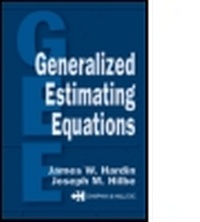
Generalized Estimating Equations
1st Edition
Published on 30. July 2002
Book
Hardback
240 pages
978-1-58488-307-4 (ISBN)
Description
Although powerful and flexible, the method of generalized linear models (GLM) is limited in its ability to accurately deal with longitudinal and clustered data. Developed specifically to accommodate these data types, the method of Generalized Estimating Equations (GEE) extends the GLM algorithm to accommodate the correlated data encountered in health research, social science, biology, and other related fields.
Generalized Estimating Equations provides the first complete treatment of GEE methodology in all of its variations. After introducing the subject and reviewing GLM, the authors examine the different varieties of generalized estimating equations and compare them with other methods, such as fixed and random effects models. The treatment then moves to residual analysis and goodness of fit, demonstrating many of the graphical and statistical techniques applicable to GEE analysis.
With its careful balance of origins, applications, relationships, and interpretation, this book offers a unique opportunity to gain a full understanding of GEE methods, from their foundations to their implementation. While equally valuable to theorists, it includes the mathematical and algorithmic detail researchers need to put GEE into practice.
Generalized Estimating Equations provides the first complete treatment of GEE methodology in all of its variations. After introducing the subject and reviewing GLM, the authors examine the different varieties of generalized estimating equations and compare them with other methods, such as fixed and random effects models. The treatment then moves to residual analysis and goodness of fit, demonstrating many of the graphical and statistical techniques applicable to GEE analysis.
With its careful balance of origins, applications, relationships, and interpretation, this book offers a unique opportunity to gain a full understanding of GEE methods, from their foundations to their implementation. While equally valuable to theorists, it includes the mathematical and algorithmic detail researchers need to put GEE into practice.
More details
Language
English
Place of publication
United States
Publishing group
Taylor & Francis Inc
Target group
College/higher education
Professional and scholarly
Statisticians; Biostatisticians working in health research and the pharmaceutical industry; Graduate Students studying longitudinal and cluster data analysis or health statistics; Statistically-oriented researchers in sociology, psychology, anthropology, biology and biometrics, fisheries, and the physical science; Econometricians
OTI #1: C1760
Illustrations
8 s/w Tabellen, 24 s/w Abbildungen
8 Tables, black and white; 24 Illustrations, black and white
Dimensions
Height: 235 mm
Width: 156 mm
Weight
476 gr
ISBN-13
978-1-58488-307-4 (9781584883074)
Copyright in bibliographic data and cover images is held by Nielsen Book Services Limited or by the publishers or by their respective licensors: all rights reserved.
Schweitzer Classification
Other editions
New editions
James W. Hardin | Joseph M. Hilbe
Generalized Estimating Equations
Book
12/2012
2nd Edition
Chapman & Hall/CRC
€145.30
Shipment within 15-20 days
Persons
Content
INTRODUCTION
Notational Conventions
A Short Review of Generalized Linear Models
Software
Exercises
MODEL CONSTRUCTION AND ESTIMATING EQUATIONS
Independent Data
Estimating the Variance of the Estimates
Panel Data
Estimation
Summary
Exercises
GENERALIZED ESTIMATING EQUATIONS
Population-Averaged (PA) and Subject-Specific (SS) Models
The PA-GEE for GLMs
The SS-GEE for GLMs
The GEE2 for GLMs
GEEs for Extensions of GLMs
Further Developments and Applications
Missing Data
Choosing an Appropriate Model
Summary
Exercises
RESIDUALS, DIAGNOSTICS, AND TESTING
Criterion Measures
Analysis of Residuals
Deletion Diagnostics
Goodness of Fit (Population-Averaged Models)
Testing Coefficients in the PA-GEE Model
Assessing the MCAR Assumption of PA-GEE Models
Summary
Exercises
PROGRAMS AND DATASETS
Programs
Datasets
References
Author Index
Subject Index
Notational Conventions
A Short Review of Generalized Linear Models
Software
Exercises
MODEL CONSTRUCTION AND ESTIMATING EQUATIONS
Independent Data
Estimating the Variance of the Estimates
Panel Data
Estimation
Summary
Exercises
GENERALIZED ESTIMATING EQUATIONS
Population-Averaged (PA) and Subject-Specific (SS) Models
The PA-GEE for GLMs
The SS-GEE for GLMs
The GEE2 for GLMs
GEEs for Extensions of GLMs
Further Developments and Applications
Missing Data
Choosing an Appropriate Model
Summary
Exercises
RESIDUALS, DIAGNOSTICS, AND TESTING
Criterion Measures
Analysis of Residuals
Deletion Diagnostics
Goodness of Fit (Population-Averaged Models)
Testing Coefficients in the PA-GEE Model
Assessing the MCAR Assumption of PA-GEE Models
Summary
Exercises
PROGRAMS AND DATASETS
Programs
Datasets
References
Author Index
Subject Index