

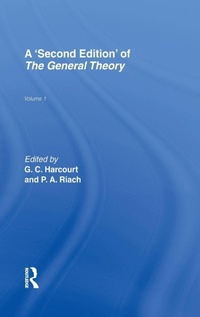
The General Theory
Volume 1
Published on 2. January 1997
Book
Hardback
560 pages
978-0-415-14942-6 (ISBN)
Description
Keynes always intended to write 'footnotes' to his masterwork The General Theory, which would take account of the criticisms made of it and allow him to develop and refine his ideas further. However, a number of factors combined to prevent him from doing so before his death in 1946. A wide range of Keynes scholars - including James Tobin, Paul Davidson and Lord Skidelsky - have written here the 'footnotes' that Keynes never did.
Reviews / Votes
'These volumes will be appreciated by Keynes scholars, old and new, for the light they tend to shine on their subject...this 'second edition' of the General Theory will assist in ensuring that the thought of the greatest economist of the twentieth century, for that is what Keynes undoubtedly was, will continue to reverberate in the minds of economists as we enter the twenty-first century. - History of Economics ReviewMore details
Edition
Revised edition
Language
English
Place of publication
London
United Kingdom
Publishing group
Taylor & Francis Ltd
Target group
College/higher education
Postgraduate and Undergraduate
Product notice
sewn/stitched
Cloth over boards
Dimensions
Height: 236 mm
Width: 164 mm
Thickness: 34 mm
Weight
871 gr
ISBN-13
978-0-415-14942-6 (9780415149426)
Copyright in bibliographic data and cover images is held by Nielsen Book Services Limited or by the publishers or by their respective licensors: all rights reserved.
Schweitzer Classification
Other editions
Additional editions
E-Book
08/2006
1st Edition
Routledge
€77.99
Available for download
E-Book
08/2006
1st Edition
Routledge
€77.99
Available for download
Book
04/2006
1st Edition
Routledge
€85.80
Shipment within 15-20 days
Persons
Professor Geoffrey Harcourt, Peter Riach
Content
I: Introduction; 1: The Relation of The General Theory to the Classical Theory; 2: On Rewriting Chapter 2 of The General Theory; 3: Effective Demand Revisited; 4: Yes, Mrs Robinson!; 5: Imperfect Competition and Keynes; 6: The Principle of Effective Demand *; II: Definitions and Units; 7: Units and Definitions *; 8: User Cost *; III: The Propensity to Consume; 9: The Propensity to Consume and the Multiplier *; 10: Keynes and Dynamics; 11: The Multiplier and Finance *; IV: The Inducement to Invest; 12: The Marginal Efficiency of Capital and Investment; 13: The Marginal Efficiency of Investment *; 14: Is There a Place for Rational Expectations in Keynes's General Theory? *; 15: Expectations and Uncertainty in Contemporary Keynesian Models *; 16: The Theory of Value, Expectations and Chapter 17 of The General Theory *; 17: Own-Rates of Interest and their Relevance for the Existence of Underemployment Equilibrium Positions *; 18: Keynes's Monetary Theory of Value and Modern Banking *; 19: The General Theory; 20: The Classical Theory of the Rate of Interest; V and VI: Money-Wages and Prices: Short Notes Suggested by the General Theory; 21: Keynesian Business Cycle Theory; 22: Notes on the Trade Cycle and Social Philosophy in a Post-Keynesian World *; 23: Underconsumption; 24: Keynes's 'Concluding Notes'