

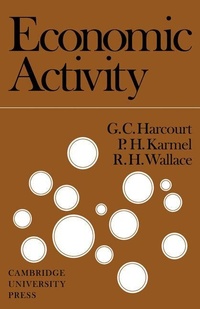
Economic Activity
Published on 2. March 1967
Book
Paperback/Softback
340 pages
978-0-521-09427-6 (ISBN)
Description
Economic Activity has its origins in a course of lectures given since 1950 to first-year undergraduates at the University of Adelaide. That course was originally given by P. H. Karmel; in later years the other two co-authors inherited it. Little attention was paid to financial factors in the first-year course. A second-year course of macro?economics (given on several occasions by R. H. Wallace) was built upon the first course, and in this the inter-relationships between the financial and production sectors of the economy were considered in detail. The second-year course was set in the context of the particular institutional framework of the Australian economy, and students were introduced to the relevant statistical material. The book draws upon material from both courses, but the discussion of the financial sector is essentially theoretical.
More details
Language
English
Place of publication
Cambridge
United Kingdom
Target group
College/higher education
Product notice
Paperback (trade)
Illustrations
Worked examples or Exercises
Dimensions
Height: 216 mm
Width: 140 mm
Thickness: 20 mm
Weight
480 gr
ISBN-13
978-0-521-09427-6 (9780521094276)
Copyright in bibliographic data and cover images is held by Nielsen Book Services Limited or by the publishers or by their respective licensors: all rights reserved.
Schweitzer Classification
Other editions
Additional editions
G. C. Harcourt | P. H. Karmel | R. H. Wallace
Economic Activity
Book
03/1967
Cambridge University Press
€27.86
Article exhausted; check for reprint
Previous edition
G. C. Harcourt | P. H. Karmel | R. H. Wallace
Economic Activity
Book
03/1967
Cambridge University Press
€27.86
Article exhausted; check for reprint
Content
1. Introduction; 2. The National Accounts and the Income-Creation Process; 3. The Production-Income-Expenditure Circuit and National Accounting Identities; 4. The Determination of the Equilibrium Level of Real Income; 5. The Concept of Full Employment; 6. Money in the Economic Process; 7. The Banking System and the Quantity of Money; 8. The Consumption Function; 9. The Determinants of Investment Expenditure; 10. The Effect of Changes in Expenditure Plans: The Multiplier Concept; 11. The Government Sector and the Determination of Real Income; 12. The Open Economy; 13. The Interaction Between Planned Expenditures and Financial Factors; 14. Inflation; 15. Economic Policy.