

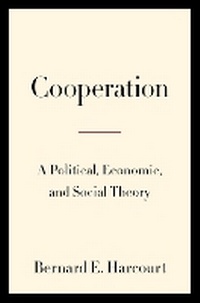
Cooperation
A Political, Economic, and Social Theory
Will be published approx. on 9. May 2023
Book
Hardback
312 pages
978-0-231-20954-0 (ISBN)
Description
Liberal democracy is in crisis around the world, unable to address pressing problems such as climate change. There is, however, another path-cooperation democracy. From consumer co-ops to credit unions, worker cooperatives to insurance mutuals, nonprofits to mutual aid, countless examples prove that people working together can extend the ideals of participatory democracy and sustainability into every aspect of their lives. These forms of cooperation do not depend on electoral politics. Instead, they harness the longstanding practices and values of cooperatives: self-determination, democratic participation, equity, solidarity, and respect for the environment.
Bernard E. Harcourt develops a transformative theory and practice that builds on worldwide models of successful cooperation. He identifies the most promising forms of cooperative initiatives and then distills their lessons into an integrated framework: Cooeperism. This is a political theory grounded on recognition of our interdependence. It is an economic theory that can ensure equitable distribution of wealth. Finally, it is a social theory that replaces the punishment paradigm with a cooperation paradigm.
A creative work of normative critical theory, Cooperation provides a positive vision for addressing our most urgent challenges today. Harcourt shows that by drawing on the core values of cooperation and the power of people working together, a new world of cooperation democracy is within our grasp.
Bernard E. Harcourt develops a transformative theory and practice that builds on worldwide models of successful cooperation. He identifies the most promising forms of cooperative initiatives and then distills their lessons into an integrated framework: Cooeperism. This is a political theory grounded on recognition of our interdependence. It is an economic theory that can ensure equitable distribution of wealth. Finally, it is a social theory that replaces the punishment paradigm with a cooperation paradigm.
A creative work of normative critical theory, Cooperation provides a positive vision for addressing our most urgent challenges today. Harcourt shows that by drawing on the core values of cooperation and the power of people working together, a new world of cooperation democracy is within our grasp.
Reviews / Votes
Bernard Harcourt's creative and courageous vision of a flexible cooperation democracy takes us far beyond the toxic impasse between conservative deregulation and liberal administrative state policies! His radical participatory democracy in all spheres also captures much of the best of abolitionist projects while remaining rooted in past and present cooperative movements. His marvelous book is badly needed in our decadent times! -- Cornel West Cooperation is a call for a new society built from existing cooperative practices and grounded in values of cooperation and mutualism. An inspiration for all who wish to move beyond the old dichotomy of capitalism and communism. -- Katharina Pistor, author of <i>The Code of Capital: How the Law Creates Wealth and Inequality</i> From climate change to mass criminalization, we are confronting a range of existential challenges. Harcourt's emphasis on cooperation as the key to confronting these challenges while building a more just society allows him to create an inspiring framework so many of us could learn from. -- Amna A. Akbar, The Ohio State University What makes his contribution unique and inspiring is precisely that he applies it to other facets of our social life, especially with the ideal of ending the punitive model of society. He joins many others in reminding us that we need not wait for society as a whole to realize a new cooperative vision; we can just cooperate at whatever level we can. * Los Angeles Review of Books * On the whole there is much to like in Harcourt's Cooperation, especially his informative introduction to the cooperative sector of the economy. For members of cooperatives, his delineation of the three aspects of what cooperation entails is worth contemplating. So too should his analysis of combining, compounding, and leveraging be studied so that the movement for a post-capitalist economy can be hastened. * Grassroots Economic Organizing *More details
Language
English
Place of publication
New York
United States
Target group
Professional and scholarly
Product notice
Trade binding
Dimensions
Height: 235 mm
Width: 156 mm
ISBN-13
978-0-231-20954-0 (9780231209540)
Copyright in bibliographic data and cover images is held by Nielsen Book Services Limited or by the publishers or by their respective licensors: all rights reserved.
Schweitzer Classification
Other editions
Additional editions

E-Book
05/2023
1st Edition
Columbia University Press
€29.49
Available for download
Person
Bernard E. Harcourt is the Isidor and Seville Sulzbacher Professor of Law and professor of political science at Columbia University and a chaired professor at the Ecole des Hautes Etudes en Sciences Sociales in Paris. An editor of Michel Foucault's work in French and English, Harcourt is the author of several books, including Critique and Praxis (Columbia, 2020). He is a social-justice litigator and the recipient of the 2019 Norman Redlich Capital Defense Distinguished Service Award from the New York City Bar Association for his longtime representation of death row prisoners.
Content
Getting Started
1. The Urgency of Cooeperism
2. The Ubiquity of Cooperation
3. The Simplicity of Cooperation
4. The Political Theory of Cooeperism
5. The Economic Theory of Cooeperism
6. The Social Theory of Cooeperism
7. A Defense of Cooeperism
8. Cooperation Democracy
Acknowledgments
Notes
Bibliography
Index
1. The Urgency of Cooeperism
2. The Ubiquity of Cooperation
3. The Simplicity of Cooperation
4. The Political Theory of Cooeperism
5. The Economic Theory of Cooeperism
6. The Social Theory of Cooeperism
7. A Defense of Cooeperism
8. Cooperation Democracy
Acknowledgments
Notes
Bibliography
Index