

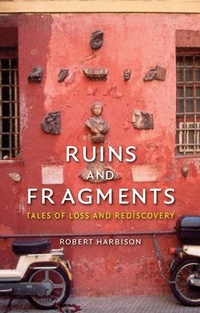
Ruins and Fragments
Tales of Loss and Rediscovery
Published on 1. May 2015
Book
Hardback
272 pages
978-1-78023-447-2 (ISBN)
Description
What is it about ruins that is so alluring, so puzzling, that they can hold us in endless wonder over the half-erased story they tell? This elegant book explores the captivating hold these remains and broken pieces - from architecture to art and literature - have on us. Why are we suspicious of things that are too smooth, too continuous? What makes us feel, when we look at a fragment, that its very incompletion has a kind of meaning in itself?
Looking at ancient fragments, Robert Harbison probes the ways we have recovered, restored and exhibited them. He moves on to modernist architecture and its own pursuit of fragmentary form, examining modern projects inserted into existing ruins, from Castelvecchio in Verona to the Neues Museum in Berlin. T. S. Eliot, Montaigne, Coleridge, Sterne and Joyce have all used fragments as the foundation for creating new work, as have visual artists, from Ruskin to Schwitters, as well as film-makers like Eisenstein and contemporary artists from Gordon Matta-Clark onwards.
From ancient to modern times and across every imaginable form of art, Ruins and Fragments takes a poetic look at how ruins have offered us a way of understanding history and have enabled us to create the new.
Looking at ancient fragments, Robert Harbison probes the ways we have recovered, restored and exhibited them. He moves on to modernist architecture and its own pursuit of fragmentary form, examining modern projects inserted into existing ruins, from Castelvecchio in Verona to the Neues Museum in Berlin. T. S. Eliot, Montaigne, Coleridge, Sterne and Joyce have all used fragments as the foundation for creating new work, as have visual artists, from Ruskin to Schwitters, as well as film-makers like Eisenstein and contemporary artists from Gordon Matta-Clark onwards.
From ancient to modern times and across every imaginable form of art, Ruins and Fragments takes a poetic look at how ruins have offered us a way of understanding history and have enabled us to create the new.
Reviews / Votes
This is a splendid book . . . Ruins and Fragments is a thoughtful, stimulating and contemplative study of the fragmentary nature of our environment . . . Its informed and opinionated text challenges the established dogmas of approaching a ruin and is dismissive of the sanctimonious certitude of self-righteous interferers . . . This is an essential text for all those responsible for ruins and fragments. Let us hope it saves some architects from ruining a ruin. * <i>RIBA Journal</i> * Drawing parallels from modernist literature and art, Harbison suggests that the ruin and the fragment appeal to contemporary sensibilities precisely because of their incompleteness and their embodiment of loss and nostalgia. With the destruction of sites of antiquity by Isis, this is a timely and beautifully written study of why we are so attached to pieces of the past. * <i>Financial Times</i>, Books of the Year * [a] teeming study of the aesthetics and reality of ruins . . . Harbison is well placed to explore these dilapidated cultural precincts . . . Robert Harbison's wide-ranging meditation on the allure of decline and decay is an erudite addition to the literature. * <i>Architecture Today</i> * there is a beauty in the symmetry between Harbisons subject matter and his style . . . those of us who love his work love precisely the way those intellectual jumbles reflect an idea about the world . . . Harbisons books . . . consistently provide brief, fragmentary glimmers of hope. * <i>The New Yorker</i> * Harbison has been chipping meticulously away at the intersection between architecture and performance, between style and intention, and potential and ruin, for his entire career. Ruins is not an easy book but its a rewarding one. The reader who sees the point of what hes trying to do will find it a finely turned spur to thought, whether its about Parisian galleries, Finnegans Wake, Montaigne, the Iliad, Detroit and the many other fragments we shore, not against our ruin, but as the very foundations of the postmodern world. * <i>The Spectator</i> * Harbison has a sharp eye for the neglected. He produces his own modernist ruin, almost to match Pruitt-Igoe (St. Peters Seminary, Cardross, in Scotland, designed in the late 1950s for a Catholic community, abandoned, then restored in the 1980s, now crumbling, covered in graffiti and desolate) and he brings to life the left-over bits of marble that went into the making of the crazy-paving paths that were laid on the Athenian Acropolis in the 1950s which every tourist walks over but few notice. There is rich store of beguiling prose too, including wonderfully lyrical celebration of the industrial wasteland of Deptford Creek (main landmark: abandoned supermarket trolleys). Cities thrive, he reflects, when remembering their unbeautiful roots in dirty industry and pungent compost of past lives. * <i>TLS</i> * The 20th Century is commonly thought of as a period obsessed with novelty and committed to destroying the past, but this book presents a history of modernity constructed in the light of ruins and fragments. It looks at architecture but also at art and literature, all interwoven in a composition of parts, visions, and also anecdotes alike only in that they belong to the same time and context: entropy, that is, disorder and annihilation. The author pulls on several guiding threads (the modern ruin, interrupted texts, destruction), stitching together a selection of authors and works he subjects to a discourse both alluring and poetic * <i>Arquitectura Viva</i> * Ruins and Fragments is a wonderfully alluring poem of absence: it weaves together such diverse strands as the language of Finnigans Wake, the montage of Eisenstein and Dziga Vertov, the aggressions of analytical Cubism and the reconstruction of the Warsaw Market Square into an enticing panorama of our perplexing times. * Joseph Rykwert, author of <i>The Judicious Eye</i>, <i>The Seduction of Place</i> and <i>The Idea of a Town</i> * A marvelous story-teller and shorer of fragments, Robert Harbison surveys the destiny of ruins from Oxyrynchus to the films of Ozu, to Phimai and beyond. Yet his underlying concern remains the aftermath of war, cruelty, suffering the perpetual assault of human folly upon human constructions and the history of our often poorly conceived attempts to rebuild. Harbison has composed a spell-binding meditation on the inevitability of fragmentation and dispersal. * Susan Stewart, Avalon Foundation University Professor of the Humanities and Director, Society of Fellows in the Liberal Arts * An extended meditation on human incompleteness, and, like true meditation, transcending its subject. * Paul Lyons, author of <i>The Eden Man</i> *More details
Language
English
Place of publication
London
United Kingdom
Illustrations
52 illustrations
Dimensions
Height: 224 mm
Width: 146 mm
Thickness: 30 mm
Weight
470 gr
ISBN-13
978-1-78023-447-2 (9781780234472)
Copyright in bibliographic data and cover images is held by Nielsen Book Services Limited or by the publishers or by their respective licensors: all rights reserved.
Schweitzer Classification
Other editions
Additional editions
E-Book
08/2015
Reaktion Books
€26.99
Available for download
Person
Robert Harbison is former Professor of Architecture at London Metropolitan University. He is the author of many books including Eccentric Spaces (1977), The Built, the Unbuilt and the Unbuildable (1991), Reflections on Baroque (Reaktion, 2000), Travels in the History of Architecture (Reaktion, 2010) and Ruins and Fragments: Tales of Loss and Rediscovery (Reaktion, 2015).