

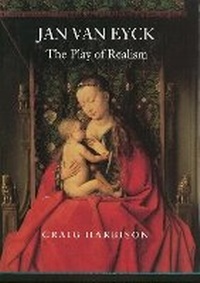
Jan van Eyck
The Play of Realism
Published on 1. October 1995
Book
Paperback/Softback
228 pages
978-0-948462-79-5 (ISBN)
Description
Jan van Eyck (1395-41) was the foremost artist of the Early Netherlandish School. Although Court painter to Duke Philip the Good of Burgundy, van Eyck's surviving work was not executed for the Duke, but for rising Court bureaucrats, Italian merchants and members of the secular clergy, for whom he created a series of painstakingly detailed oil paintings of astonishing verisimilitude. Most explanations of the meanings behind these paintings have been grounded in the disguised religious symbolism critics have insisted are uppermost in them. Van Eyck, it is said, followed traditional theology in this respect - albeit in sophisticated ways; his realist art displayed in iconic and allusive forms the conventional symbols of Church teaching and popular piety.
But in Jan van Eyck: The Play of Realism, such approaches to the art of this Netherlandish master are set aside. In a fascinating recovery of the neglected human dimension that is present in these works, Craig Harbison interrogates the personal histories of the worldly participants of such masterpieces as the Virgin and Child with George van der Paele, the Arnolfini Double Portrait and the Virgin and Child with Nicolis Rolin. In addition to exploring the domestic and financial circumstances of the sitters, the author reveals the remarkable degree to which they were caught up in the wider social and spiritual concerns of the early fifteenth century, including the increasing abuse of indulgences and benefices, the rise of religious scepticism and the spread of popular, anti-clerical private prayer.
Since Jan van Eyck's patrons sought to have themselves portrayed as both worldly and devout, the artist set out to satisfy this demand, but in a form of realism that contained within itself a playful, even, ironic, attitude towards the relations existing between individuals, society, religion - and, of course, the various forms of representation then available. As the author demonstrates - with the aid of abundant visual evidence in colour and in black and white - the artful mesh of pictured aspirations and ambivalences making up the painted world van Eyck invented are found always to be constructed along particular artistic and psychological fault-lines. By tracing these out for the reader, Harbison reveals how van Eyck presented his contemporaries with a more subtle and complex view of the value of appearances as a route to understanding the meaning of life.
But in Jan van Eyck: The Play of Realism, such approaches to the art of this Netherlandish master are set aside. In a fascinating recovery of the neglected human dimension that is present in these works, Craig Harbison interrogates the personal histories of the worldly participants of such masterpieces as the Virgin and Child with George van der Paele, the Arnolfini Double Portrait and the Virgin and Child with Nicolis Rolin. In addition to exploring the domestic and financial circumstances of the sitters, the author reveals the remarkable degree to which they were caught up in the wider social and spiritual concerns of the early fifteenth century, including the increasing abuse of indulgences and benefices, the rise of religious scepticism and the spread of popular, anti-clerical private prayer.
Since Jan van Eyck's patrons sought to have themselves portrayed as both worldly and devout, the artist set out to satisfy this demand, but in a form of realism that contained within itself a playful, even, ironic, attitude towards the relations existing between individuals, society, religion - and, of course, the various forms of representation then available. As the author demonstrates - with the aid of abundant visual evidence in colour and in black and white - the artful mesh of pictured aspirations and ambivalences making up the painted world van Eyck invented are found always to be constructed along particular artistic and psychological fault-lines. By tracing these out for the reader, Harbison reveals how van Eyck presented his contemporaries with a more subtle and complex view of the value of appearances as a route to understanding the meaning of life.
Reviews / Votes
"An enthralling study" - The Sunday Telegraph"Admirably restores a sense of Van Eycks singularity and modernity. [A] highly original book." - The Art Bulletin
"A fascinating investigation into the nature of the great pioneers clients" - Arts Review
More details
Language
English
Place of publication
London
United Kingdom
Target group
Professional and scholarly
Illustrations
132 illustrations, 44 illustrations
Dimensions
Height: 280 mm
Width: 210 mm
ISBN-13
978-0-948462-79-5 (9780948462795)
Copyright in bibliographic data and cover images is held by Nielsen Book Services Limited or by the publishers or by their respective licensors: all rights reserved.
Schweitzer Classification
Other editions
New editions
Book
06/2011
2nd Edition
Reaktion Books
€47.24
Article not available at the moment
Person
Craig Harbison is Professor Emeritus of Art History at the University of Massachusetts, Amherst. Among his publications is The Mirror of the Artist: Northern Renaissance Art in its Historical Context (1995).