

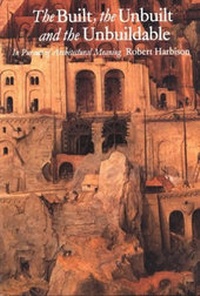
The Built, the Unbuilt & the Unbuildable
In Pursuit of Architectural Meaning
Published on 4. May 1993
Book
Paperback/Softback
192 pages
978-0-262-58122-6 (ISBN)
Description
The pristine, the ruined, the ephemeral, and even the notional are the
subject of Robert Harbison's highly original and admittedly romantic contribution to
the literature of architecture. His fresh perceptions open this practical art to new
interpretations as he explores the means by which buildings, real or imagined, evade
or surpass functional necessities while sometimes satisfying them.What fascinates
Harbison in these discussions are the paradoxes and ironies of function that give
rise to meaning, to a psychological impact that may or may not have been intended.
He chooses examples from an architectural borderland - of gardens, monuments, ideal
cities and fortification, ruins, paintings, and unbuildable buildings -where use and
symbolism overlap; he examines the exceptions at the edges of a field that will
illuminate its center.Harbison's pursuit of man's efforts to "fashion art from
nonhuman life" begins with a consideration of gardens and the organic architecture
of the English Arts and Crafts movement and of Gaudi, then turns to monuments (Claes
Oldenburg, Christo, the Vietnam Memorial) that are "either the nearest or the
furthest thing from gardens." Harbison's discussion of fortification and urban
planning leads to metaphorical themes (fort-features in churches or prisons or
Fascist municipal buildings) and mocked-up worlds (Williamsburg, Disneyland), and to
the subject of fictional space as expressed in ruins, in painting, in the
unbuildable, and finally in the inconceivable as revealed in Kafka's sketches.Robert
Harbison has lectured widely on architecture at the Museum of Modern Art in New
York, the University of Toronto, Stanford University, Cornell University, and the
Architectural Association, London. His previous books include Eccentric Spaces,
Deliberate Regression, and Pharaoh's Dream.
Robert Harbison reads architecture as one would read poetry for meaning.
Meaning, he finds, resides especially in those works of architecture that are
unnecessary, having outlived their physical functions or never having been intended
to have any. Gardens, monuments, historic fortifications, and ruins are among the
examples he uses to reveal the secret meanings of this architecture "freed from
function."Robert Harbison has lectured widely on architecture at the Museum of Modem
Art in New York, the University of Toronto, Stanford University, Cornell University,
and the Architectural Association, London. His previous books include Eccentric
Spaces, Deliberate Regression, and Pharaoh's Dream.
subject of Robert Harbison's highly original and admittedly romantic contribution to
the literature of architecture. His fresh perceptions open this practical art to new
interpretations as he explores the means by which buildings, real or imagined, evade
or surpass functional necessities while sometimes satisfying them.What fascinates
Harbison in these discussions are the paradoxes and ironies of function that give
rise to meaning, to a psychological impact that may or may not have been intended.
He chooses examples from an architectural borderland - of gardens, monuments, ideal
cities and fortification, ruins, paintings, and unbuildable buildings -where use and
symbolism overlap; he examines the exceptions at the edges of a field that will
illuminate its center.Harbison's pursuit of man's efforts to "fashion art from
nonhuman life" begins with a consideration of gardens and the organic architecture
of the English Arts and Crafts movement and of Gaudi, then turns to monuments (Claes
Oldenburg, Christo, the Vietnam Memorial) that are "either the nearest or the
furthest thing from gardens." Harbison's discussion of fortification and urban
planning leads to metaphorical themes (fort-features in churches or prisons or
Fascist municipal buildings) and mocked-up worlds (Williamsburg, Disneyland), and to
the subject of fictional space as expressed in ruins, in painting, in the
unbuildable, and finally in the inconceivable as revealed in Kafka's sketches.Robert
Harbison has lectured widely on architecture at the Museum of Modern Art in New
York, the University of Toronto, Stanford University, Cornell University, and the
Architectural Association, London. His previous books include Eccentric Spaces,
Deliberate Regression, and Pharaoh's Dream.
Robert Harbison reads architecture as one would read poetry for meaning.
Meaning, he finds, resides especially in those works of architecture that are
unnecessary, having outlived their physical functions or never having been intended
to have any. Gardens, monuments, historic fortifications, and ruins are among the
examples he uses to reveal the secret meanings of this architecture "freed from
function."Robert Harbison has lectured widely on architecture at the Museum of Modem
Art in New York, the University of Toronto, Stanford University, Cornell University,
and the Architectural Association, London. His previous books include Eccentric
Spaces, Deliberate Regression, and Pharaoh's Dream.
More details
Language
English
Place of publication
Cambridge, Mass.
United States
Publishing group
MIT Press Ltd
Product notice
Paperback (trade)
Illustrations
130
Dimensions
Height: 229 mm
Width: 152 mm
Thickness: 0 mm
Weight
0 gr
ISBN-13
978-0-262-58122-6 (9780262581226)
Copyright in bibliographic data and cover images is held by Nielsen Book Services Limited or by the publishers or by their respective licensors: all rights reserved.
Schweitzer Classification