

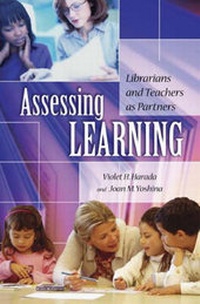
Assessing Learning
Librarians and Teachers as Partners
Published on 30. June 2005
Book
Paperback/Softback
168 pages
978-1-59158-200-7 (ISBN)
Description
Focusing on the role of library media specialists in assessing student learning, this is the first full-length book written to address its practical application in the school library media center. It is an important book for school librarians to consider as they address their role as teachers in schools and the accountability issues associated with that role. It places students at the center of the assessment equation and addresses the following topics as they relate specifically to school library instructional programs: purposes of assessment, essential elements of assessment, knowing what to assess, multiple methods for assessment, and management and communication of assessment results. The book's primary audiences are library media specialists and teachers in K-12 settings. It is also relevant for other educators, who are centrally involved in K-12 programs including district, regional and state library media coordinators, building level administrators, and library school educators. The authors cull from their own 30-year careers as library practitioners, university instructors, and workshop presenters to present doable, practical methods for the library media specialist to be involved in assessing student learning. Though this topic appears in the theoretical literature and is addressed in journal articles or chapters in contributed books, this is the first practical in-depth analysis for the school library field.
Focusing on the role of library media specialists in assessing student learning, this is the first full-length book written to address its practical application in the school library media center. It is an important book for school librarians to consider as they address their role as teachers in schools and the accountability issues associated with that role. It places students at the center of the assessment equation and addresses the following topics as they relate specifically to school library instructional programs: purposes of assessment, essential elements of assessment, knowing what to assess, multiple methods for assessment, and management and communication of assessment results. The book's primary audiences are library media specialists and teachers in K-12 settings. It is also relevant for other educators, who are centrally involved in K-12 programs including district, regional and state library media coordinators, building level administrators, and library school educators. The authors cull from their own 30-year careers as library practitioners, university instructors, and workshop presenters to present doable, practical methods for the library media specialist to be involved in assessing student learning. Though this topic appears in the theoretical literature and is addressed in journal articles or chapters in contributed books, this is the first practical in-depth analysis for the school library field. Grades K-12.
Focusing on the role of library media specialists in assessing student learning, this is the first full-length book written to address its practical application in the school library media center. It is an important book for school librarians to consider as they address their role as teachers in schools and the accountability issues associated with that role. It places students at the center of the assessment equation and addresses the following topics as they relate specifically to school library instructional programs: purposes of assessment, essential elements of assessment, knowing what to assess, multiple methods for assessment, and management and communication of assessment results. The book's primary audiences are library media specialists and teachers in K-12 settings. It is also relevant for other educators, who are centrally involved in K-12 programs including district, regional and state library media coordinators, building level administrators, and library school educators. The authors cull from their own 30-year careers as library practitioners, university instructors, and workshop presenters to present doable, practical methods for the library media specialist to be involved in assessing student learning. Though this topic appears in the theoretical literature and is addressed in journal articles or chapters in contributed books, this is the first practical in-depth analysis for the school library field. Grades K-12.
Reviews / Votes
"School library media specialists will find the practical tools they need to assess student learning in this book. Included are useful checklists, rubrics, logs, graphic organizers, examples of student portfolios, and sample lessons for all levels. The book also covers how to communicate results to teachers, administrators, and the larger community." - Curriculum Connections "One of the most important books of the year on assessment. Highly recommended." - Teacher Librarian "The question now is: How do we assess student learing in the context of the school media center? This is the first book to answer this question. K-12 media specialists will find this book invaluable in understanding and implementing assessment of student learning and achievement. Each chapter begins with an overview and key questions that are answered in the reading, and ends with an extensive list of print and Internet references....Recommended." - Library Media Connection "[T]hese two experienced Hawaii librarians offer terrific ideas at all grade levels for assessing (formatively) and evaluating (summatively) both our work and that of our students. After reviewing the topic of assessment, the authors look at library media centers to determine where and how students should be assessed and then examine assessment tools and explain a wide array of effective graphic organizers. In a flashback to excellent outcome-based learning strategies (renamed backward planning), they detail units for elementary, middle, and high schools using varied assessments, most extensively student portfolios....While newer teacher-librarians may learn some of these strategies in library school, veterans should be excited at possibilities that they may never have considered, thus providing much-needed injections of clear, accessible, exciting instruction into their lives as well as those of their students" - School Library JournalMore details
Language
English
Place of publication
United States
Publishing group
Bloomsbury Publishing Plc
Target group
College/higher education
Professional and scholarly
ISBN-13
978-1-59158-200-7 (9781591582007)
Copyright in bibliographic data and cover images is held by Nielsen Book Services Limited or by the publishers or by their respective licensors: all rights reserved.
Schweitzer Classification
Persons
Violet H. Harada is Professor of Library and Information Science at the University of Hawaii where she also coordinates the specialization for school library media preparation. In her 35-year career she has been a secondary English teacher, an elementary school library media specialist, a state level administrator, and a curriculum designer. In her current research and publications, she focuses on inquiry-based approaches to information seeking and use and on the dynamics of collaborative instruction. With Joan M. Yoshina, she is the co-author of Learning Through Inquiry: Librarian-Teacher Partnerships.
Joan M. Yoshina recently retired from the Hawaii Department of Education after 34 years as an elementary and high school teacher, a language arts specialist, and a library media specialist. She worked in both elementary and middle school libraries in Oahu. Joan has also published articles on the information search process and integrated instruction, guest lectured at the University of Hawaii, and presented her work at both state and national conferences.
Joan M. Yoshina recently retired from the Hawaii Department of Education after 34 years as an elementary and high school teacher, a language arts specialist, and a library media specialist. She worked in both elementary and middle school libraries in Oahu. Joan has also published articles on the information search process and integrated instruction, guest lectured at the University of Hawaii, and presented her work at both state and national conferences.