

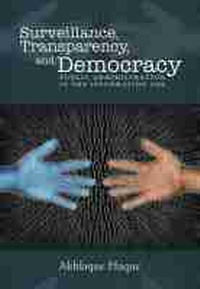
Surveillance, Transparency, and Democracy
Public Administration in the Information Age
Published on 31. August 2015
Book
Hardback
184 pages
978-0-8173-1877-2 (ISBN)
Description
Surveillance, Transparency, and Democracy investigates public administra-tion's increasing dependence on technology and how its pervasive use in complex and interrelated socioeconomic and political affairs has out-stripped the ability of many public administrators and the public to grasp the consequences of their choices. Akhlaque Haque sees the contradic-tion at the core of a public that seeks services that require a level of data collection that triggers fears of a tyrannical police state.
In this well-informed yet anxious age, public administrators have con-structed vast cisterns that collect and interpret a meteoric shower of facts. In Surveillance, Transparency, and Democracy, Akhlaque Haque demon-strates that this pervasive use and increasing dependence on informa-tion technology (IT) enables sophisticated and well-intentioned public services that nevertheless risk deforming public policy decision-making.
In chapter 1, Haque explains that information has become a vital re-source, offering a theoretical framework for its analysis. In chapter 2, he shows that an organization's information-gathering skill is reflected in its IT sophistication, but warns that successful IT strategies can by stunted by symbolic but shallow gestures such as the appointment of a "Chief Information Officer." Chapter 3 outlines how the dependence on IT can create a reflex for IT solutions that fail to reflect the values of the citizenry they're intended to serve.
Chapter 4 posits that IT's potential as a tool for human development depends on how civil servants and citizens actively engage in identifying desired outcomes, map IT solutions to those outcomes, and routinize the applications of those solutions. This leads to his call in chapter 5 for the development of entrepreneurs who generate innovative solutions to criti-cal human needs. In his powerful summary in chapter 6, Haque recaps possible answers to the question: "What is the best way a public institu-tion can apply technology to improving the human condition?"
Haque masterfully flexes between crisp logical arguments and a deep empathy for human values. He finds apt metaphors that bring multifac-eted scenarios into clear focus for experts and laymen alike. Engrossing, challenging, and important, Surveillance, Transparency, and Democracy is essential reading for both policy makers as well as the great majority of readers and citizens engaged in contemporary arguments about the role of government, public health and security, individual privacy, data collec-tion, and surveillance.
In this well-informed yet anxious age, public administrators have con-structed vast cisterns that collect and interpret a meteoric shower of facts. In Surveillance, Transparency, and Democracy, Akhlaque Haque demon-strates that this pervasive use and increasing dependence on informa-tion technology (IT) enables sophisticated and well-intentioned public services that nevertheless risk deforming public policy decision-making.
In chapter 1, Haque explains that information has become a vital re-source, offering a theoretical framework for its analysis. In chapter 2, he shows that an organization's information-gathering skill is reflected in its IT sophistication, but warns that successful IT strategies can by stunted by symbolic but shallow gestures such as the appointment of a "Chief Information Officer." Chapter 3 outlines how the dependence on IT can create a reflex for IT solutions that fail to reflect the values of the citizenry they're intended to serve.
Chapter 4 posits that IT's potential as a tool for human development depends on how civil servants and citizens actively engage in identifying desired outcomes, map IT solutions to those outcomes, and routinize the applications of those solutions. This leads to his call in chapter 5 for the development of entrepreneurs who generate innovative solutions to criti-cal human needs. In his powerful summary in chapter 6, Haque recaps possible answers to the question: "What is the best way a public institu-tion can apply technology to improving the human condition?"
Haque masterfully flexes between crisp logical arguments and a deep empathy for human values. He finds apt metaphors that bring multifac-eted scenarios into clear focus for experts and laymen alike. Engrossing, challenging, and important, Surveillance, Transparency, and Democracy is essential reading for both policy makers as well as the great majority of readers and citizens engaged in contemporary arguments about the role of government, public health and security, individual privacy, data collec-tion, and surveillance.
More details
Series
Language
English
Place of publication
Alabama
United States
Target group
College/higher education
Professional and scholarly
Illustrations
6 black and white illustrations
Dimensions
Height: 229 mm
Width: 152 mm
Weight
456 gr
ISBN-13
978-0-8173-1877-2 (9780817318772)
Copyright in bibliographic data and cover images is held by Nielsen Book Services Limited or by the publishers or by their respective licensors: all rights reserved.
Schweitzer Classification
Other editions
Additional editions
Akhlaque Haque
Surveillance, Transparency, and Democracy
Public Administration in the Information Age
E-Book
08/2015
1st Edition
University of Alabama Press
€63.99
Available for download
Persons
Akhlaque Haque is an associate professor of government at the Univer-sity of Alabama at Birmingham, USA. His scholarship has appeared widely in peer-reviewed journals, among them Public Administration Review, Admin-istration and Society, Social Science Computer Review, Public Administration Quarterly, and the International Journal of Public Administration.