

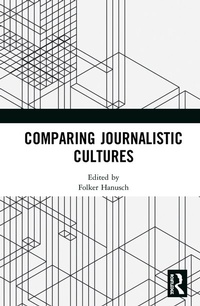
Comparing Journalistic Cultures
1st Edition
Published on 29. October 2019
Book
Hardback
170 pages
978-0-367-36258-4 (ISBN)
Description
This book offers an analysis of journalists' professional views against a variety of political, economic, social, cultural, and linguistic contexts.
Based on data gathered for the Worlds of Journalism Study, which conducted surveys with more than 27,000 journalists in 67 countries, the authors explore aspects such as linguistic and religious influences on journalists' identities, journalists' views of development journalism, epistemic issues, as well as the relationship between journalism and democracy. Further, the book provides a history of the evolution of the Worlds of Journalism Study, as well as the challenges of conducting such comparative work across a wide range of contexts. A critical review by renowned comparative studies scholar Jay Blumler offers food for thought for future endeavours.
This unprecedented collaborative effort will be essential reading for scholars and students of journalism who are interested in comparative approaches to journalism studies and who want to explore the wide variety of journalism cultures that exist around the globe.
It was originally published as a special issue of Journalism Studies.
Based on data gathered for the Worlds of Journalism Study, which conducted surveys with more than 27,000 journalists in 67 countries, the authors explore aspects such as linguistic and religious influences on journalists' identities, journalists' views of development journalism, epistemic issues, as well as the relationship between journalism and democracy. Further, the book provides a history of the evolution of the Worlds of Journalism Study, as well as the challenges of conducting such comparative work across a wide range of contexts. A critical review by renowned comparative studies scholar Jay Blumler offers food for thought for future endeavours.
This unprecedented collaborative effort will be essential reading for scholars and students of journalism who are interested in comparative approaches to journalism studies and who want to explore the wide variety of journalism cultures that exist around the globe.
It was originally published as a special issue of Journalism Studies.
More details
Language
English
Place of publication
London
United Kingdom
Publishing group
Taylor & Francis Ltd
Target group
College/higher education
Postgraduate and Undergraduate
Dimensions
Height: 246 mm
Width: 174 mm
Weight
500 gr
ISBN-13
978-0-367-36258-4 (9780367362584)
Copyright in bibliographic data and cover images is held by Nielsen Book Services Limited or by the publishers or by their respective licensors: all rights reserved.
Schweitzer Classification
Other editions
Additional editions
Folker Hanusch
Comparing Journalistic Cultures
Book
06/2021
1st Edition
Routledge
€63.20
Shipment within 10-20 days
Folker Hanusch
Comparing Journalistic Cultures
E-Book
05/2020
1st Edition
Routledge
€55.49
Available for download
Folker Hanusch
Comparing Journalistic Cultures
E-Book
05/2020
1st Edition
Routledge
€55.49
Available for download
Person
Folker Hanusch is a Professor of Journalism in the Department of Communication at the University of Vienna, Austria, and an Adjunct Professor at Queensland University of Technology, Brisbane, Australia. He currently serves as an editor-in-chief of Journalism Studies. His research interests are in comparative journalism studies, journalism culture, Indigenous journalism, and journalism and everyday life.
Content
Introduction - Comparing Journalistic Cultures Across Nations: What we can learn from the Worlds of Journalism Study 1. Quelle Difference? Language, culture and nationality as influences on francophone journalists' identity 2. Journalism and Islamic Worldview: Journalistic roles in Muslim-majority countries 3. Journalists' Development Journalism Role Perceptions: Select countries in Southeast Asia, South Asia and sub-Saharan Africa 4. A Welfare State of Mind? Nordic journalists' conception of their role and autonomy in international context 5. New Roles For Media in the Western Balkans: A study of transitional journalism 6. In Media We Trust: Journalists and institutional trust perceptions in post-authoritarian and post-totalitarian countries 7. Expanding Influences Research to Insecure Democracies: How violence, public insecurity, economic inequality and uneven democratic performance shape journalists' perceived work environments 8. News Cultures or "Epistemic Cultures"? Theoretical considerations and empirical data from 62 countries 9. Epilogue for a Comparative Leap Forward