

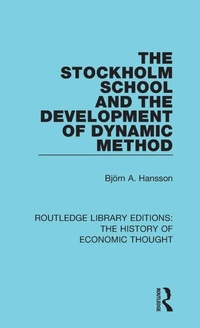
The Stockholm School and the Development of Dynamic Method
1st Edition
Published on 18. January 2017
Book
Hardback
294 pages
978-1-138-23020-0 (ISBN)
Description
This book, first published in 1982, provides a thorough analysis of the Stockholm School's contribution to the development of dynamic methods. It examines the work of such key figures as Myrdal, Lundberg and Lindahl and provides new insights on their work. It discusses the connections between the Stockholm School and Keynesian revolution, and shows how the Stockholm School were the precursors of many contemporary ideas. This title will be of interest to students of economics.
More details
Series
Language
English
Place of publication
London
United Kingdom
Publishing group
Taylor & Francis Ltd
Target group
College/higher education
Dimensions
Height: 222 mm
Width: 145 mm
Thickness: 20 mm
Weight
511 gr
ISBN-13
978-1-138-23020-0 (9781138230200)
Copyright in bibliographic data and cover images is held by Nielsen Book Services Limited or by the publishers or by their respective licensors: all rights reserved.
Schweitzer Classification
Other editions
Additional editions
Bjoern A. Hansson
The Stockholm School and the Development of Dynamic Method
Book
07/2018
1st Edition
Routledge
€39.90
Shipment within 10-20 days
Bjoern A. Hansson
The Stockholm School and the Development of Dynamic Method
E-Book
02/2017
Routledge
€35.49
Available for download
Bjoern A. Hansson
The Stockholm School and the Development of Dynamic Method
E-Book
02/2017
Routledge
€35.49
Available for download
Person
Björn A. Hansson
Content
Preface; 1. Introduction 2. The Analytical Framework 3. The 'Method of Expectations': Myrdal's Dissertation (1927) 4. The Equilibrium Approach: Lindahl's Development of Intertemporal and Temporal Equilibrium (1929-1930) 5. The Equilibrium Approach (cont'd) 6. A Critique of Static Equilibrium Theory: Lundberg (1930) 7. The Disequilibrium Approach: Myrdal's Development of Ex Ante and Ex Post (1931-1932) 8. Profit as a Link Between Consecutive Periods: Hammarskjoeld (1932-1933) 9. Autonomous Changes in Consumption Demand: Ohlin (1932-1934) 10. A Fully Developed Sequence Analysis: Lindahl (1934-1935) 11. Disequilibrium Sequence Analysis: Lundberg (1937) 12. The Immediate Response to The General Theory 13. Summary; Bibliography; Appendix