

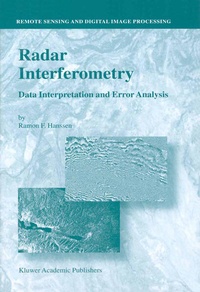
Radar Interferometry
Data Interpretation and Error Analysis
Published on 30. April 2001
Book
Hardback
XVIII, 308 pages
978-0-7923-6945-5 (ISBN)
Description
This book is the product of five and a half years of research dedicated to the und- standing of radar interferometry, a relatively new space-geodetic technique for m- suring the earth's topography and its deformation. The main reason for undertaking this work, early 1995, was the fact that this technique proved to be extremely useful for wide-scale, fine-resolution deformation measurements. Especially the interf- ometric products from the ERS-1 satellite provided beautiful first results-several interferometric images appeared as highlights on the cover of journals such as Nature and Science. Accuracies of a few millimeters in the radar line of sight were claimed in semi-continuous image data acquired globally, irrespective of cloud cover or solar illumination. Unfortunately, because of the relative lack of supportive observations at these resolutions and accuracies, validation of the precision and reliability of the results remained an issue of concern. From a geodetic point of view, several survey techniques are commonly available to measure a specific geophysical phenomenon. To make an optimal choice between these techniques it is important to have a uniform and quantitative approach for describing the errors and how these errors propagate to the estimated parameters. In this context, the research described in this book was initiated. It describes issues involved with different types of errors, induced by the sensor, the data processing, satellite positioning accuracy, atmospheric propagation, and scattering character- tics. Nevertheless, as the first item in the subtitle "Data Interpretation and Error Analysis" suggests, data interpretation is not always straightforward.
Reviews / Votes
From the reviews:
"As satellite coverage improves, radar interferometric techniques are becoming powerful and accessible tools for geodetic studies. . and are also applicable to the study of atmospheric conditions. . a guidebook for people who are already familiar with the method. . In conclusion, this is a well written, well presented book . . This book should be quite useful as a guide for applying InSAR techniques and evaluating the possible errors and the confidence to be placed on the results." (F. A. Nava, Pure and Applied Geophysics, Vol. 168, 2011)More details
Series
Edition
2001
Language
English
Place of publication
Dordrecht
Netherlands
Target group
Professional and scholarly
Research
Illustrations
95 s/w Abbildungen, 80 farbige Abbildungen
XVIII, 308 p. 175 illus., 80 illus. in color.
Dimensions
Height: 260 mm
Width: 183 mm
Thickness: 25 mm
Weight
891 gr
ISBN-13
978-0-7923-6945-5 (9780792369455)
DOI
10.1007/0-306-47633-9
Schweitzer Classification
Other editions
Additional editions
Book
12/2010
Springer
€246.09
Shipment within 15-20 days
E-Book
04/2006
Kluwer Academic Publishers
€234.33
Available for download
Content
Radar system theory and interferometric processing.- Functional model for radar interferometry.- Stochastic model for radar interferometry.- Data analysis and interpretation for deformation monitoring.- Atmospheric monitoring.- Conclusions and recommendations.