

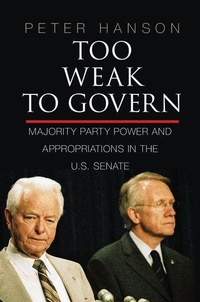
Too Weak to Govern
Majority Party Power and Appropriations in the US Senate
Published on 24. November 2014
Book
Hardback
208 pages
978-1-107-06315-0 (ISBN)
Description
Too Weak to Govern investigates the power of the majority party in the United States Senate through a study of the appropriations process over a period of nearly four decades. It uses quantitative analysis, case studies, and interviews with policy makers to show that the majority party is more likely to abandon routine procedures for passing spending bills in favor of creating massive 'omnibus' spending bills when it is small, divided, and ideologically distant from the minority. This book demonstrates that the majority party's ability to influence legislative outcomes is greater than previously understood but that it operates under important constraints. However, the majority generally cannot use its power to push its preferred policies through to approval. Overall, the weakness of the Senate majority party is a major reason for the breakdown of the congressional appropriations process over the past forty years.
Reviews / Votes
'Peter Hanson's experience in the Senate gives him substantial insight into the chamber. He explains the challenge of leading the Senate and how contention on the floor is linked to the breakdown of the appropriations process. This is a valuable book for policy makers, students and anyone interested in understanding today's Senate.' Tom Daschle, former Senator and Senate Majority Leader 'In an era when congressional parties are often described as all-powerful managers of legislative agendas, Peter Hanson's excellent study of budgetary politics in the modern Congress highlights the limits of party influence. Drawing on extensive fieldwork and thoughtful data analysis, Hanson highlights critical gaps between our theories of congressional parties and the real-world organizations these theories supposedly describe.' William T. Bianco, Indiana University 'In this important study, Peter Hanson demonstrates that the rise of massive omnibus spending bills reflects the often-desperate efforts of Senate majorities to defend their reputation for governance, rather than an effort to dictate policy. Contrary to prevailing models of party government, Hanson shows that majority leaders' aggressive actions actually reflect their party's weakness and divisions, rather than its strength.' Eric Schickler, Professor, Jeffrey and Ashley McDermott Endowed Chair and Department Chair, University of California, Berkeley 'In short, Too Weak to Govern is a worthy contribution to our understanding of the US Senate. It not only shows that majority parties in the chamber can exercise influence in the appropriations process but also shows the conditions under which they do. Those who maintain that Senate parties and their leaders are without power or, conversely, that they are effectively the same as their counterparts in the House will have to reckon with Hanson's fine tome.' Matthew N. Green, Perspectives on PoliticsMore details
Language
English
Place of publication
Cambridge
United Kingdom
Target group
Professional and scholarly
College/higher education
Illustrations
25 Tables, unspecified; 46 Line drawings, unspecified
Dimensions
Height: 235 mm
Width: 157 mm
Thickness: 16 mm
Weight
459 gr
ISBN-13
978-1-107-06315-0 (9781107063150)
Copyright in bibliographic data and cover images is held by Nielsen Book Services Limited or by the publishers or by their respective licensors: all rights reserved.
Schweitzer Classification
Other editions
Additional editions
Book
11/2014
Cambridge University Press
€37.30
Shipment within 15-20 days
E-Book
11/2014
Cambridge University Press
€19.49
Available for download
E-Book
10/2014
1st Edition
Cambridge University Press
€20.49
Available for download
Person
Peter Hanson is an Assistant Professor of Political Science at the University of Denver and a former staff member in the office of Senator Tom Daschle (D-SD). He has been interviewed by national and international media organizations, including the BBC, Agence France-Presse, the New York Times online's 'FiveThirtyEight' blog, USA Today, Minnesota Public Radio, Colorado Public Radio, Rocky Mountain PBS, and the Denver Post. He co-led the University of Denver's 'Colorado Voter Poll' in 2012.
Content
List of figures; List of tables; Preface; Acknowledgments; 1. The limited-influence theory of the Senate; 2. Testing expectations; 3. The first wave (1979-87); 4. Back to the regular order; 5. The second wave (1995-2012); 6. Conclusion.