

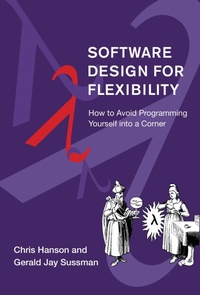
Software Design for Flexibility
How to Avoid Programming Yourself into a Corner
Published on 9. March 2021
Book
Hardback
448 pages
978-0-262-04549-0 (ISBN)
Description
Strategies for building large systems that can be easily adapted for new situations with only minor programming modifications.
Time pressures encourage programmers to write code that works well for a narrow purpose, with no room to grow. But the best systems are evolvable; they can be adapted for new situations by adding code, rather than changing the existing code. The authors describe techniques they have found effective--over their combined 100-plus years of programming experience--that will help programmers avoid programming themselves into corners.
The authors explore ways to enhance flexibility by:
Time pressures encourage programmers to write code that works well for a narrow purpose, with no room to grow. But the best systems are evolvable; they can be adapted for new situations by adding code, rather than changing the existing code. The authors describe techniques they have found effective--over their combined 100-plus years of programming experience--that will help programmers avoid programming themselves into corners.
The authors explore ways to enhance flexibility by:
- Organizing systems using combinators to compose mix-and-match parts, ranging from small functions to whole arithmetics, with standardized interfaces
- Augmenting data with independent annotation layers, such as units of measurement or provenance
- Combining independent pieces of partial information using unification or propagation
- Separating control structure from problem domain with domain models, rule systems and pattern matching, propagation, and dependency-directed backtracking
- Extending the programming language, using dynamically extensible evaluators
More details
Language
English
Place of publication
Cambridge (Massachusetts)
United States
Publishing group
MIT Press Ltd
Dimensions
Height: 236 mm
Width: 158 mm
Thickness: 35 mm
Weight
727 gr
ISBN-13
978-0-262-04549-0 (9780262045490)
Copyright in bibliographic data and cover images is held by Nielsen Book Services Limited or by the publishers or by their respective licensors: all rights reserved.
Schweitzer Classification
Other editions
Additional editions
Chris Hanson | Gerald Jay Sussman
Software Design for Flexibility
How to Avoid Programming Yourself into a Corner
E-Book
03/2021
MIT Press
€53.99
Available for download
Persons
Chris Hanson is on the technical staff at Datera.
Gerald Jay Sussman is Panasonic Professor of Electrical Engineering at MIT. He is the coauthor of Structure and Interpretation of Computer Programs, Structure and Interpretation of Classical Mechanics, and Functional Differential Equations (all published by the MIT Press).
Gerald Jay Sussman is Panasonic Professor of Electrical Engineering at MIT. He is the coauthor of Structure and Interpretation of Computer Programs, Structure and Interpretation of Classical Mechanics, and Functional Differential Equations (all published by the MIT Press).
Content
Foreword xi
Preface xiii
Acknowledgments xix
1 Flexibility in Nature and in Design 1
2 Domain-Specific Languages 21
3 Variations on an Arithmetic Theme 67
4 Pattern Matching 157
5 Evaluation 233
6 Layering 299
7 Propagation 327
8 Epilogue 373
A Appendix: Supporting Software 377
B Appendix: Scheme 379
Preface xiii
Acknowledgments xix
1 Flexibility in Nature and in Design 1
2 Domain-Specific Languages 21
3 Variations on an Arithmetic Theme 67
4 Pattern Matching 157
5 Evaluation 233
6 Layering 299
7 Propagation 327
8 Epilogue 373
A Appendix: Supporting Software 377
B Appendix: Scheme 379