

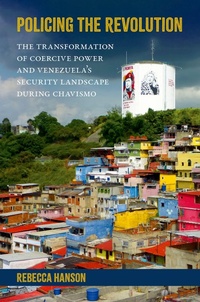
Policing the Revolution
The Transformation of Coercive Power and Venezuela's Security Landscape During Chavismo
Published on 23. May 2025
Book
Paperback/Softback
280 pages
978-0-19-768082-7 (ISBN)
Description
Since the mid-2000s Venezuela has been ranked one of the most violent countries in the world as homicides and police violence skyrocketed. Much has been written about the country's turn to Chavismo but scholarship has ignored what will perhaps be the revolution's most important legacy: how Chavista policies transformed coercive power and the security landscape.
In Policing the Revolution, Rebecca Hanson provides the first in-depth analysis of policing and security policies during the Bolivarian Revolution in Venezuela, focusing on the experiences of three groups: police officers, police reformers, and residents of neighborhoods most affected by violence. Drawing on ethnographic, interview, and survey research collected over ten years, she analyzes how security policies within the context of the pink tide and later turn to authoritarianism contributed to the expansion of lateral violence and the pluralization of non-state armed actors. Far from the always-already authoritarian project proposed by many scholars and pundits, Hanson shows that the Bolivarian Revolution was defined by highly contested and contrasting visions of security that resulted in a fragmented and inconsistent ordering of state and society. Moreover, by pairing the vantage point of street-level police officers with that of ordinary barrio residents, she provides a unique analysis of how insecurity during revolution was experienced "from below."
Rethinking the relationship between revolution, violence, and state-building, this book is essential reading to understand how and why violence increased so dramatically in Venezuela in the twenty-first century.
In Policing the Revolution, Rebecca Hanson provides the first in-depth analysis of policing and security policies during the Bolivarian Revolution in Venezuela, focusing on the experiences of three groups: police officers, police reformers, and residents of neighborhoods most affected by violence. Drawing on ethnographic, interview, and survey research collected over ten years, she analyzes how security policies within the context of the pink tide and later turn to authoritarianism contributed to the expansion of lateral violence and the pluralization of non-state armed actors. Far from the always-already authoritarian project proposed by many scholars and pundits, Hanson shows that the Bolivarian Revolution was defined by highly contested and contrasting visions of security that resulted in a fragmented and inconsistent ordering of state and society. Moreover, by pairing the vantage point of street-level police officers with that of ordinary barrio residents, she provides a unique analysis of how insecurity during revolution was experienced "from below."
Rethinking the relationship between revolution, violence, and state-building, this book is essential reading to understand how and why violence increased so dramatically in Venezuela in the twenty-first century.
Reviews / Votes
Hanson's Policing the Revolution provides counterintuitive insights into the nature of politics and the state in Bolivarian Venezuela. The book addresses important and complex puzzles that fit Venezuela into debates about violence in Latin America, highlighting similarities but also key differences. Hanson perceptively shows that violence and crime in Venezuela emerge, in part, because of decisions made by state leaders that keep the police disorganized, thus reducing their capacity to engage in effective law enforcement and shifting the balance of police power in the country. Hanson's detailed and incisive ethnography of Venezuelan police provides critical insights into politics in that country and its police forces. * Desmond Arias, Marxe Chair in Western Hemisphere Affairs, Baruch College-CUNY * Our understanding of contemporary Venezuela has been impeded by broad brushstroke analyses that fail to penetrate some of the most important phenomena at play. Based on ten years of careful fieldwork-including participant observation with police officers in the most difficult of circumstances-Hanson provides one of the most insightful books that has been written on the Chavista period. Rather than the classic story of state-sponsored violence in service of authoritarian control, she reveals the pluralization of violent actors and the continual destabilization of relations between them. Hanson's access point is a focus on policing and security, but this is a book about the Bolivarian Revolution. All Venezuela scholars need to engage this text. * David Smilde, Favrot Professor of Human Relations, Tulane University * Policing the Revolution is a remarkable book offering an extraordinarily comprehensive account of the evolution of Venezuela's Bolivarian Revolution and Chavismo through the lens of policing and coercion, offering one of the few (and certainly the most robust) analysis to date on the left's approaches to security. The book's deep ethnographic approach masterfully pairs a focus on street-level officers with the vantage point of ordinary barrio residents to analyze how the revolution is experienced "from below." Rarely do we see ethnographies that consider police officers alongside the communities that bear the brunt of their abuses. By considering both perspectives jointly, we get a more nuanced and realistic understanding of the everyday practices that lay bare the contradictions of the Bolivarian Revolution * Yanilda Gonzalez, Professor of Public Policy at the Harvard Kennedy School *More details
Series
Language
English
Place of publication
New York
United States
Target group
College/higher education
Product notice
Paperback (trade)
Unsewn / adhesive bound
Dimensions
Height: 234 mm
Width: 158 mm
Thickness: 20 mm
Weight
358 gr
ISBN-13
978-0-19-768082-7 (9780197680827)
Copyright in bibliographic data and cover images is held by Nielsen Book Services Limited or by the publishers or by their respective licensors: all rights reserved.
Schweitzer Classification
Other editions
Additional editions

Rebecca Hanson
Policing the Revolution
The Transformation of Coercive Power and Venezuela's Security Landscape During Chavismo
Book
07/2025
Oxford University Press Inc
€79.23
Shipment within 15-20 days
Rebecca Hanson
Policing the Revolution
The Transformation of Coercive Power and Venezuela's Security Landscape During Chavismo
E-Book
03/2025
OUP eBook
€18.49
Available for download
Rebecca Hanson
Policing the Revolution
The Transformation of Coercive Power and Venezuela's Security Landscape During Chavismo
E-Book
03/2025
OUP eBook
€18.49
Available for download
Person
Rebecca Hanson is Assistant Professor at the University of Florida, with a joint appointment in the Department of Sociology and Criminology & Law and the Center for Latin American Studies and director of UF's International Ethnography Lab. Her research focuses on how policies and political changes that seek to reduce inequality and violence end up contributing to these problems and how changing modalities of violence in the 21st century affect state building and capacity, with a specific focus on policing. She is the coauthor of Harassed: Gender, Bodies, and Ethnographic Research (University of California Press, 2019) and co-editor of The Paradox of Violence in Venezuela: Revolution, Crime, and Policing during Chavismo (University of Pittsburgh Press, 2022).
Content
List of Illustrations
Chapter 1: Introduction
Chapter 2: Research Design, Methods, and Embodied Ethnography
Chapter 3: Reform and its Discontents
Chapter 4: Securing the Revolution Part I
Chapter 5: Malandros Uniformados: Masculinity, Marginalization, Insecurity, and Attitudes on Police Violence
Chapter 6: The New Socialist Mother and Her Fight against Crime
Chapter 7: Caiga quien Cagia: Systematic Killing in Maduro's Venezuela
Chapter 8: Securing the Revolution Part II
Chapter 9: Conclusion
Index
Chapter 1: Introduction
Chapter 2: Research Design, Methods, and Embodied Ethnography
Chapter 3: Reform and its Discontents
Chapter 4: Securing the Revolution Part I
Chapter 5: Malandros Uniformados: Masculinity, Marginalization, Insecurity, and Attitudes on Police Violence
Chapter 6: The New Socialist Mother and Her Fight against Crime
Chapter 7: Caiga quien Cagia: Systematic Killing in Maduro's Venezuela
Chapter 8: Securing the Revolution Part II
Chapter 9: Conclusion
Index