

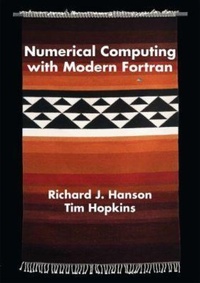
Numerical Computing with Modern FORTRAN
Published on 16. January 2014
Book
Paperback/Softback
260 pages
978-1-61197-311-2 (ISBN)
Description
The Fortran language standard has undergone significant upgrades in recent years (1990, 1995, 2003, and 2008). Numerical Computing with Modern Fortran illustrates many of these improvements through practical solutions to a number of scientific and engineering problems.
- Readers will discover techniques for modernizing algorithms written in Fortran; examples of Fortran interoperating with C or C++ programs, plus using the IEEE floating-point standard for efficiency; illustrations of parallel Fortran programming using coarrays, MPI, and OpenMP; and a supplementary website with downloadable source codes discussed in the book.
- Audience: This book is intended for Fortran programmers seeking to update their programming skills using the language's latest features and for C and C++ programmers who want to understand key software aspects of numerical computing using modern Fortran. It is suitable for an upper-level undergraduate or early graduate course on advanced numerical scientific computing.
More details
Persons
Richard J. Hanson has more than five decades of practical experience in the development of mathematical software. He has worked in academia, for the United States government, and for private software firms. He now has his own consulting business and is currently working on a new parallel version of the ARPACK eigenvalue package.
Tim Hopkins is the current algorithms editor for ACM Transactions on Mathematical Software and has four decades of experience writing and testing scientific application codes in Fortran. He worked as a lecturer in the School of Computer Science at the University of Kent for 35 years before retiring in 2010. He has been a member of IFIP Working Group 2.5 on Numerical Software since 2003 and is currently writing parallel simulation codes for Bergen Software Services International, using Fortran and MPI.
Tim Hopkins is the current algorithms editor for ACM Transactions on Mathematical Software and has four decades of experience writing and testing scientific application codes in Fortran. He worked as a lecturer in the School of Computer Science at the University of Kent for 35 years before retiring in 2010. He has been a member of IFIP Working Group 2.5 on Numerical Software since 2003 and is currently writing parallel simulation codes for Bergen Software Services International, using Fortran and MPI.
Content
Introduction; 1. The modern Fortran source; 2. Modules for subprogram libraries; 3. Generic subprograms; 4. Sparse matrices, defined operations, overloaded assignment; 5. Object-oriented programming for numerical applications; 6. Recursion in Fortran; 7. Case study: toward a modern QUADPACK routine; 8. Case study: quadrature routine qag2003; 9. IEEE arithmetic features and exception handling; 10. Interoperability with C; 11. Defined operations for sparse matrix solutions; 12. Case study: two sparse least-squares system examples; 13. Message passing with MPI in standard Fortran; 14. Coarrays in standard Fortran; 15. OpenMP in Fortran; 16. Modifying source to remove obsolescent or deleted features; 17. Software testing; 18. Compilers; 19. Software tools; 20. Fortran book code on SIAM web site; Bibliography; Index.