

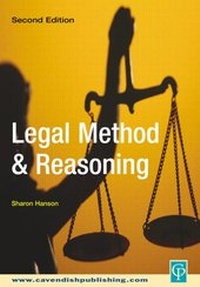
Legal Method and Reasoning
Published on 30. June 2003
Book
Paperback/Softback
496 pages
978-1-85941-783-6 (ISBN)
Description
Language skills,study skills, argument skills and legal knowledge are vital to every law student, professional lawyer and academic. Legal Method Reasoning offers a range of 'how to' techniques for acquiring these skills. It shows how to handle and use legal texts, how to read and write about the law, how to acquire disciplined study techniques and how to construct legal arguments.
This new edition will be of value to both undergraduate and postgraduate law students.
This new edition will be of value to both undergraduate and postgraduate law students.
Reviews / Votes
'All the information is very clearly presented. Each Chapter has set learning outcomes, and information is helpfully broken down into bullet points, tables and flow charts. Each chapter ends with a case study, applying the principles that have been taught. The book should help students to think logically and analytically, and suggest how to apply theoretical principles to practical situations'. The Trainee Magazine, Autumn 2004More details
Language
English
Place of publication
London
United Kingdom
Publishing group
Taylor & Francis Ltd
Target group
Professional and scholarly
Dimensions
Height: 229 mm
Width: 152 mm
Weight
454 gr
ISBN-13
978-1-85941-783-6 (9781859417836)
Copyright in bibliographic data and cover images is held by Nielsen Book Services Limited or by the publishers or by their respective licensors: all rights reserved.
Schweitzer Classification
Other editions
Previous edition

Sharon Hanson
Legal Method
Book
03/1999
Routledge Cavendish
€48.46
Article exhausted; check for reprint
Person
Sharon Hanson, LLB, MA, is Director of the Legal Studies Programme and Director of the Theology Diploma in the Faculty of Continuing Education at Birkbeck College, University of London.
Content
Introduction; The Power of Language; Reading and Understanding Legislation; Reading and Understanding Law Reports; Reading English Law: The European Dimension; Reading Books About Law: A Reading Strategy; Legal Argument Construction; Writing: Essays and Answers to Problem Questions; A Demonstration: Using Primary and Secondary Legal Texts to Construct Arguments in Answer to One Particular Question; Conclusion.