

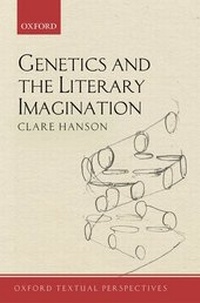
Genetics and the Literary Imagination
Published on 13. May 2020
Book
Hardback
212 pages
978-0-19-881328-6 (ISBN)
Description
Oxford Textual Perspectives is a series of informative and provocative studies focused upon literary texts (conceived of in the broadest sense of that term) and the technologies, cultures, and communities that produce, inform, and receive them. It provides fresh interpretations of fundamental works and of the vital and challenging issues emerging in English literary studies. By engaging with the materiality of the literary text, its production, and reception history, and frequently testing and exploring the boundaries of the notion of text itself, the volumes in the series question familiar frameworks and provide innovative interpretations of both canonical and less well-known works.
This is the first book to explore the dramatic impact of genetics on literary fiction over the past four decades. After James Watson and Francis Crick's discovery of the structure of DNA in 1953 and the subsequent cracking of the genetic code, a gene-centric discourse developed which had a major impact not only on biological science but on wider culture. As figures like E. O. Wilson and Richard Dawkins popularised the neo-Darwinian view that behaviour was driven by genetic self-interest, novelists were both compelled and unnerved by such a vision of the origins and ends of life. This book maps the ways in which Doris Lessing, A.S. Byatt, Ian McEwan, and Kazuo Ishiguro wrestled with the reductionist neo-Darwinian account of human nature and with the challenge it posed to humanist beliefs about identity, agency, and morality. It argues that these novelists were alienated to varying degrees by neo-Darwinian arguments but that the recent shift to postgenomic science has enabled a greater rapprochement between biological and (post)humanist concepts of human nature. The postgenomic view of organisms as agentic and interactive is echoed in the life-writing of Margaret Drabble and Jackie Kay, which also explores the ethical implications of this holistic biological perspective. As advances in postgenomics, especially epigenetics, provoke increasing public interest and concern, this book offers a timely analysis of debates that have fundamentally altered our understanding of what it means to be human.
This is the first book to explore the dramatic impact of genetics on literary fiction over the past four decades. After James Watson and Francis Crick's discovery of the structure of DNA in 1953 and the subsequent cracking of the genetic code, a gene-centric discourse developed which had a major impact not only on biological science but on wider culture. As figures like E. O. Wilson and Richard Dawkins popularised the neo-Darwinian view that behaviour was driven by genetic self-interest, novelists were both compelled and unnerved by such a vision of the origins and ends of life. This book maps the ways in which Doris Lessing, A.S. Byatt, Ian McEwan, and Kazuo Ishiguro wrestled with the reductionist neo-Darwinian account of human nature and with the challenge it posed to humanist beliefs about identity, agency, and morality. It argues that these novelists were alienated to varying degrees by neo-Darwinian arguments but that the recent shift to postgenomic science has enabled a greater rapprochement between biological and (post)humanist concepts of human nature. The postgenomic view of organisms as agentic and interactive is echoed in the life-writing of Margaret Drabble and Jackie Kay, which also explores the ethical implications of this holistic biological perspective. As advances in postgenomics, especially epigenetics, provoke increasing public interest and concern, this book offers a timely analysis of debates that have fundamentally altered our understanding of what it means to be human.
Reviews / Votes
Her analysis is insightful and her prose... is extremely readable. Highly recommended. Upper-division undergraduates through faculty. * E. R. Baer, Gustavus Adolphus College, CHOICE *More details
Series
Language
English
Place of publication
Oxford
United Kingdom
Target group
College/higher education
Dimensions
Height: 212 mm
Width: 144 mm
Thickness: 18 mm
Weight
358 gr
ISBN-13
978-0-19-881328-6 (9780198813286)
Copyright in bibliographic data and cover images is held by Nielsen Book Services Limited or by the publishers or by their respective licensors: all rights reserved.
Schweitzer Classification
Other editions
Additional editions
Clare Hanson
Genetics and the Literary Imagination
Book
05/2020
Oxford University Press
€39.10
Shipment within 15-20 days
Clare Hanson
Genetics and the Literary Imagination
E-Book
05/2020
1st Edition
OUP eBook
€24.99
Available for download
Person
Clare Hanson is Emeritus Professor of English at the University of Southampton. She is author and editor of 11 books including A Cultural History of Pregnancy: Pregnancy, Medicine and Culture 1750-2000 (Palgrave, 2004), Eugenics, Literature and Culture in Post-war Britain (Routledge, 2012), Katherine Mansfield and Psychology (with Gerri Kimber and Todd Martin, Edinburgh UP, 2016), and The History of British Women's Writing Vol 9, 1945-1975 (with Susan Watkins, Palgrave, 2017).
Content
Introduction: The Secret of Life
1: Doris Lessing's Evolutionary Epic
2: A.S. Byatt's Biological Reason
3: Ian McEwan: the Literary Animal
4: Clone Lives: Eva Hoffman and Kazuo Ishiguro
5: Postgenomic Histories: Margaret Drabble and Jackie Kay
1: Doris Lessing's Evolutionary Epic
2: A.S. Byatt's Biological Reason
3: Ian McEwan: the Literary Animal
4: Clone Lives: Eva Hoffman and Kazuo Ishiguro
5: Postgenomic Histories: Margaret Drabble and Jackie Kay