

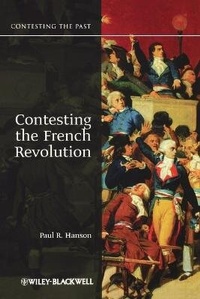
Contesting the French Revolution
1st Edition
Published on 27. January 2009
Book
Paperback/Softback
248 pages
978-1-4051-6084-1 (ISBN)
Description
Contesting the French Revolution provides an insightful overview of one of history's most significant events, as well as examining the most significant historiographical debates about this period.
Explores the causes, events, and consequences of the French Revolution
Offers a stimulating analysis of the most controversial debates: Were the events of 1789 a social revolution or a political accident? Did they mark the rise of industrial capitalism or the birth of modern democracy? Was Napoleon Bonaparte an heir to the ideals of 1789 or a betrayer of the Revolution?
Shows how historical interpretation of the French Revolution has been influenced by the changing political and social currents of the last 200 years - from the Russian Revolution to the fall of the Berlin Wall - and how historical study has shifted from a political focus to social and cultural approaches in more recent years.
Explores the causes, events, and consequences of the French Revolution
Offers a stimulating analysis of the most controversial debates: Were the events of 1789 a social revolution or a political accident? Did they mark the rise of industrial capitalism or the birth of modern democracy? Was Napoleon Bonaparte an heir to the ideals of 1789 or a betrayer of the Revolution?
Shows how historical interpretation of the French Revolution has been influenced by the changing political and social currents of the last 200 years - from the Russian Revolution to the fall of the Berlin Wall - and how historical study has shifted from a political focus to social and cultural approaches in more recent years.
Reviews / Votes
"This book offers the best and most comprehensive narrative of the French Revolution published in decades. In a brief synthesis, Paul Hanson presents a riveting account and a fascinating exploration of the scholarly debates. Most impressive is Hanson's knowledge of all the fields of research and his achievement in bringing them together in a highly readable book." (European History Quarterly, 2011) "The historiography of the French Revolution is notoriously voluminous. Paul Hanson is one of very few people who can be said to have mastered it." (Informaworld.com, January 2011)"Appropriately for a book centred on the notion of debate, Hanson includes an innovative interactive element: at the end of the Acknowledgements he provides an email address to which readers are invited to send 'comments, suggestions, and criticisms' (p. ix). I, for one, intend to take up the invitation in order to congratulate him on a job well done." (French Studies, December 2010)
"Recommended [for] Graduate students [and] faculty." (CHOICE, February 2010) Designed as an introduction both to the Revolution and to the historical controversies that surround it, Contesting the French Revolution is an assured, erudite survey of recent scholarship by an accomplished historian of the Revolution. (H-France, April 2010)
More details
Series
Language
English
Place of publication
Hoboken
United Kingdom
Publishing group
John Wiley and Sons Ltd
Target group
College/higher education
Dimensions
Height: 230 mm
Width: 152 mm
Thickness: 20 mm
Weight
381 gr
ISBN-13
978-1-4051-6084-1 (9781405160841)
Copyright in bibliographic data and cover images is held by Nielsen Book Services Limited or by the publishers or by their respective licensors: all rights reserved.
Schweitzer Classification
Other editions
Additional editions

Paul R. Hanson
Contesting the French Revolution
Book
01/2009
1st Edition
Wiley
€110.12
Shipment within 3-4 weeks
Person
Paul Hanson is Professor of History at Butler University in Indianapolis. He has taught courses on French history, European history, and Chinese history, and has published numerous books and articles examining the French Revolution, including The Jacobin Republic under Fire, Provincial Politics in the French Revolution and Historical Dictionary of the French Revolution.
Content
Acknowledgements. Chronology.
Introduction.
1. Origins: Inevitable Revolution or Resolvable Crisis?
2. 1789.
3. The Declaration of Rights and the Abolition of Feudalism.
4. Constitutional Monarchy.
5. The Republic.
6. Regeneration and Terror.
7. Thermidor and the Directory.
8. Napoleon: Heir to the Revolution?
9. Revolutionary Violence.
10. Legacy of the Revolution.
Bibliography.
Index.
Introduction.
1. Origins: Inevitable Revolution or Resolvable Crisis?
2. 1789.
3. The Declaration of Rights and the Abolition of Feudalism.
4. Constitutional Monarchy.
5. The Republic.
6. Regeneration and Terror.
7. Thermidor and the Directory.
8. Napoleon: Heir to the Revolution?
9. Revolutionary Violence.
10. Legacy of the Revolution.
Bibliography.
Index.