

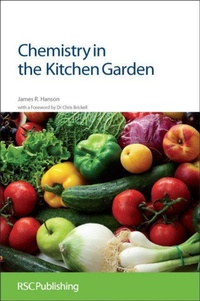
Chemistry in the Kitchen Garden
Published on 9. September 2011
Book
Hardback
224 pages
978-1-84973-323-6 (ISBN)
Description
Over the past decade there has been a resurgence of interest in growing fruit and vegetables in the garden and on the allotment. Part of the driving force behind this is an increased awareness of the health benefits that can be derived from fruit and vegetables in the diet. The 'five helpings a day' dictum reflects the correlation between a regular consumption of fruit and vegetables and a reduced incidence of, for example, cardiovascular disease and some cancers. Growing your own vegetables provides the opportunity to harvest them at their peak, to minimize the time for post-harvest deterioration prior to consumption and to reduce their 'food miles'. It also provides an opportunity to grow interesting and less common cultivars. The combination of economic advantages and recreational factors add to the pleasure of growing fruit and vegetables.
This book covers the natural products that have been identified in common 'home-grown' fruit and vegetables and which contribute to their organoleptic and beneficial properties. Over the last fifty years the immense advances in separation methods and spectroscopic techniques for structure elucidation have led to the identification of a wide range of natural products in fruit and vegetables. Not only have many of their beneficial properties been recognized but also their ecological roles in the development of plants have been identified. The functional role of many of these natural products is to mediate the balance between an organism and its environment in terms of microbial, herbivore or plant to plant interactions.
The book is aimed at readers with a chemical background who wish to know a little more about the natural products that they are eating, their beneficial effects, and the roles that these compounds have in nature. Developments in the understanding of the ecological and beneficial chemistry of fruit and vegetables have made the exploration of their chemical diversity a fascinating and expanding area of natural product chemistry and readers will obtain some 'taste' for this chemistry from the book. It develops in more detail the relevant sections from the earlier RSC book 'Chemistry in the Garden'.
The book begins with an outline of the major groups of compound that are found in fruit and vegetables. This is followed by a description of aspects of environmental chemistry that contribute to the successful cultivation of these crops. Subsequent chapters deal with individual plants which are grouped in terms of the part of the plant, roots, bulbs and stems, leaves, seeds, that are used for food. The final chapters deal with fruit and herbs. The epilogue considers some general aspects of ecological chemistry and climatic stress which may, in the future, affect the growth of fruit and vegetables in the garden particularly in the context of potential climate changes. The book concludes with a section on further reading, a glossary of terms used in plant chemistry and a list of the common fruit and vegetables grouped in their plant families.
This book covers the natural products that have been identified in common 'home-grown' fruit and vegetables and which contribute to their organoleptic and beneficial properties. Over the last fifty years the immense advances in separation methods and spectroscopic techniques for structure elucidation have led to the identification of a wide range of natural products in fruit and vegetables. Not only have many of their beneficial properties been recognized but also their ecological roles in the development of plants have been identified. The functional role of many of these natural products is to mediate the balance between an organism and its environment in terms of microbial, herbivore or plant to plant interactions.
The book is aimed at readers with a chemical background who wish to know a little more about the natural products that they are eating, their beneficial effects, and the roles that these compounds have in nature. Developments in the understanding of the ecological and beneficial chemistry of fruit and vegetables have made the exploration of their chemical diversity a fascinating and expanding area of natural product chemistry and readers will obtain some 'taste' for this chemistry from the book. It develops in more detail the relevant sections from the earlier RSC book 'Chemistry in the Garden'.
The book begins with an outline of the major groups of compound that are found in fruit and vegetables. This is followed by a description of aspects of environmental chemistry that contribute to the successful cultivation of these crops. Subsequent chapters deal with individual plants which are grouped in terms of the part of the plant, roots, bulbs and stems, leaves, seeds, that are used for food. The final chapters deal with fruit and herbs. The epilogue considers some general aspects of ecological chemistry and climatic stress which may, in the future, affect the growth of fruit and vegetables in the garden particularly in the context of potential climate changes. The book concludes with a section on further reading, a glossary of terms used in plant chemistry and a list of the common fruit and vegetables grouped in their plant families.
More details
Language
English
Place of publication
Cambridge
United Kingdom
Product notice
Unsewn / adhesive bound
Dimensions
Height: 248 mm
Width: 164 mm
Thickness: 20 mm
Weight
560 gr
ISBN-13
978-1-84973-323-6 (9781849733236)
DOI
10.1039/9781839168246
Copyright in bibliographic data and cover images is held by Nielsen Book Services Limited or by the publishers or by their respective licensors: all rights reserved.
Schweitzer Classification
Other editions
Additional editions
James R. Hanson
Chemistry in the Kitchen Garden
E-Book
11/2015
1st Edition
Royal Society of Chemistry
€34.49
Available for download
Person
Professor J R Hanson FRSC is Emeritus Professor of Chemistry at the University of Sussex. Early work on gibberellic acid at ICI has lead to a long and successful career in natural product and organic chemistry, documented by numerous research papers and books. In 2008 Professor Hanson received a Service Award from the RSC journal Natural Product Reports for his dedicated contribution to the journal, as author and editorial board member. Professor Hanson continues to teach chemistry and biochemistry and is a keen gardener.
Content
The Natural Products of Fruit and Vegetables;
Chemistry and the Growing Environment;
Root, Bulb and Stem Vegetables;
Green Leaf Vegetables;
Seed Vegetables;
Greenhouse Crops;
Fruit Trees and Bushes;
Culinary Herbs;
Epilogue;
Further Reading;
Glossary;
Index
Chemistry and the Growing Environment;
Root, Bulb and Stem Vegetables;
Green Leaf Vegetables;
Seed Vegetables;
Greenhouse Crops;
Fruit Trees and Bushes;
Culinary Herbs;
Epilogue;
Further Reading;
Glossary;
Index