

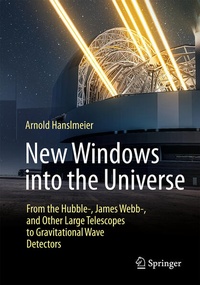
New Windows into the Universe
Description
The observation capabilities of modern astrophysics are constantly increasing. They range from optical telescopes and space telescopes in the infrared to radio telescopes, and from gravitational wave detectors to neutrino observatories. While some focus on light in space, others examine the smallest particles underwater or measure disturbances in spacetime smaller than the diameter of a proton. This book offers an exciting and comprehensive overview of our technical capabilities to explore the universe. It is just as suitable as a foundation for a lecture in astronomy or astrophysics as it is for reading by those interested in the natural sciences.
Reviews / Votes
"Dr. Hanslmeier has written a wonderful introduction to the cosmos that is accessible to anyone with an interest in 'what's out there and how do we see it.' . This is a short book which covers a wide range of topics at a general science level. . Dr. Hanslmeier has written a concise and thoughtful introduction to the heavens. It was a pleasure to read." (David S. Mazel, MAA Reviews, maa.org, May 15, 2026)
More details
Other editions
Additional editions
Person
Arnold Hanslmeier is a professor of astrophysics and was the director of the Institute of Physics at the University of Graz. Research stays and his positions as a guest professor have taken him to locations such as Toulouse, Freiburg, Innsbruck, Tenerife, Vienna, Zagreb, and Slovakia. His repertoire is diverse: lectures for interested laypeople, experienced author of educational, popular science, and specialized books, as well as photographs taken at his private observatory, among other things. In 2023, the asteroid 182674 was named in his honor.
Content
The Light of the Stars.- Telescopes - Eyes into the Universe.- Light from the Edge of the Universe - The World of Galaxies.- The Radio Sky.- Gravitational Waves - A New Window into the Cosmos.- Neutrinos - Ghost Particles.- The Hubble Space Telescope.- The James Webb Telescope.