

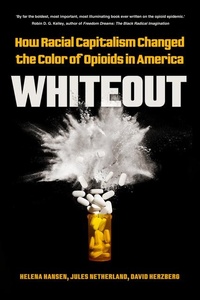
Whiteout
How Racial Capitalism Changed the Color of Opioids in America
1st Edition
Published on 28. March 2023
Book
Hardback
384 pages
978-0-520-38405-7 (ISBN)
Description
The first critical analysis of how Whiteness drove the opioid crisis.
In the past two decades, media images of the surprisingly white "new face" of the US opioid crisis abounded. But why was the crisis so white? Some argued that skyrocketing overdoses were "deaths of despair" signaling deeper socioeconomic anguish in white communities. Whiteout makes the counterintuitive case that the opioid crisis was the product of white racial privilege as well as despair.
Anchored by interviews, data, and riveting firsthand narratives from three leading experts-an addiction psychiatrist, a policy advocate, and a drug historian-Whiteout reveals how a century of structural racism in drug policy, and in profit-oriented medical industries led to mass white overdose deaths. The authors implicate racially segregated health care systems, the racial assumptions of addiction scientists, and relaxed regulation of pharmaceutical marketing to white consumers. Whiteout is an unflinching account of how racial capitalism is toxic for all Americans.
In the past two decades, media images of the surprisingly white "new face" of the US opioid crisis abounded. But why was the crisis so white? Some argued that skyrocketing overdoses were "deaths of despair" signaling deeper socioeconomic anguish in white communities. Whiteout makes the counterintuitive case that the opioid crisis was the product of white racial privilege as well as despair.
Anchored by interviews, data, and riveting firsthand narratives from three leading experts-an addiction psychiatrist, a policy advocate, and a drug historian-Whiteout reveals how a century of structural racism in drug policy, and in profit-oriented medical industries led to mass white overdose deaths. The authors implicate racially segregated health care systems, the racial assumptions of addiction scientists, and relaxed regulation of pharmaceutical marketing to white consumers. Whiteout is an unflinching account of how racial capitalism is toxic for all Americans.
Reviews / Votes
"Psychiatrist and anthropologist Hansen, policy advocate and sociologist Netherland, and historian Herzberg richly scrutinise drug use and race along multiple axes that include medicine, public policy, and history to emerge with a powerful portrait of precisely how the social construct of race and systemic racism have both created and blinded us to the unequal treatment of Black and white drug users. Through anthropology, personal histories, and nuanced data analysis this troika engages in textured, deeply researched, scholarship." * Lancet * "A thorough, incisive, and well researched book. . . . . As a history of the modern opioid crisis-from its origins in the nineteenth century to fentanyl today-you can't get much more complete."* Social History of Alcohol and Drugs journal *
More details
Edition
First Edition
Language
English
Place of publication
Berkerley
United States
Target group
Professional and scholarly
Product notice
Cloth over boards
Illustrations
19 b-w illustrations
Dimensions
Height: 231 mm
Width: 157 mm
Thickness: 30 mm
Weight
658 gr
ISBN-13
978-0-520-38405-7 (9780520384057)
Copyright in bibliographic data and cover images is held by Nielsen Book Services Limited or by the publishers or by their respective licensors: all rights reserved.
Schweitzer Classification
Other editions
Additional editions
Helena Hansen | Jules Netherland | David Herzberg
Whiteout
How Racial Capitalism Changed the Color of Opioids in America
E-Book
03/2023
1st Edition
Naval Institute Press
€24.49
Available for download
Persons
Helena Hansen is an addiction psychiatrist and anthropologist and Professor of Psychiatry and Anthropology at the University of California, Los Angeles.
Jules Netherland is a sociologist and policy advocate and Managing Director of the Department of Research and Academic Engagement at the Drug Policy Alliance.
David Herzberg is a historian and Professor of History at the State University of New York at Buffalo.
Jules Netherland is a sociologist and policy advocate and Managing Director of the Department of Research and Academic Engagement at the Drug Policy Alliance.
David Herzberg is a historian and Professor of History at the State University of New York at Buffalo.
Content
Contents
List of Illustrations
Acknowledgments
Time Line
PART ONE. TECHNOLOGIES OF WHITENESS IN THE CLINIC, THE STATEHOUSE, AND THE ARCHIVE
1. Pharmakon of Racial Poisons and Cures
(as told by Helena Hansen, psychiatrist-anthropologist)
2. How to See Whiteness
(as told by all three authors)
3. Good Samaritans in the War on Drugs That Wasn't
(as told by Jules Netherland, policy analyst)
4. "Mother's Little Helpers": White Narcotics in the Medicine Cabinet
(as told by David Herzberg, historian)
PART TWO. THREE OPIODS: RACIAL BIOGRAPHIES
5. OxyContin's Racial Precision
6. Buprenorphine's Silent White Revolution
7. The Housewife's Return to Heroin (and Forays into
Fentanyl)
8. From Racial Capitalism to Biosocial Justice
Glossary
Notes
Bibliography
Index
List of Illustrations
Acknowledgments
Time Line
PART ONE. TECHNOLOGIES OF WHITENESS IN THE CLINIC, THE STATEHOUSE, AND THE ARCHIVE
1. Pharmakon of Racial Poisons and Cures
(as told by Helena Hansen, psychiatrist-anthropologist)
2. How to See Whiteness
(as told by all three authors)
3. Good Samaritans in the War on Drugs That Wasn't
(as told by Jules Netherland, policy analyst)
4. "Mother's Little Helpers": White Narcotics in the Medicine Cabinet
(as told by David Herzberg, historian)
PART TWO. THREE OPIODS: RACIAL BIOGRAPHIES
5. OxyContin's Racial Precision
6. Buprenorphine's Silent White Revolution
7. The Housewife's Return to Heroin (and Forays into
Fentanyl)
8. From Racial Capitalism to Biosocial Justice
Glossary
Notes
Bibliography
Index