

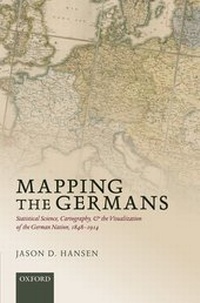
Mapping the Germans
Statistical Science, Cartography, and the Visualization of the German Nation, 1848-1914
Published on 22. January 2015
Book
Hardback
224 pages
978-0-19-871439-2 (ISBN)
Description
Mapping the Germans explores the development of statistical science and cartography in Germany between the beginning of the nineteenth century and the start of World War One, examining their impact on the German national identity. It asks how spatially-specific knowledge about the nation was constructed, showing the contested and difficult nature of objectifying this frustratingly elastic concept. Ideology and politics were not themselves capable of providing satisfactory answers to questions about the geography and membership of the nation; rather, technology also played a key role in this process, helping to produce the scientific authority needed to make the resulting maps and statistics realistic. In this sense, Mapping the Germans is about how the abstract idea of the nation was transformed into a something that seemed objectively measurable and politically manageable.
Jason Hansen also examines the birth of radical nationalism in central Europe, advancing the novel argument that it was changes to the vision of nationality rather than economic anxieties or ideological shifts that radicalized nationalist practice at the close of the nineteenth century. Numbers and maps enabled activists to "see" nationality in local and spatially-specific ways, enabling them to make strategic decisions about where to best direct their resources. In essence, they transformed nationality into something that was actionable, that ordinary people could take real actions to influence.
Jason Hansen also examines the birth of radical nationalism in central Europe, advancing the novel argument that it was changes to the vision of nationality rather than economic anxieties or ideological shifts that radicalized nationalist practice at the close of the nineteenth century. Numbers and maps enabled activists to "see" nationality in local and spatially-specific ways, enabling them to make strategic decisions about where to best direct their resources. In essence, they transformed nationality into something that was actionable, that ordinary people could take real actions to influence.
Reviews / Votes
Hansen's book shows that mapping nationality is inherently prone to bias, that statistics can be easily tweaked, and maps can be manipulated for propaganda. * Antje Petty, Max Kade Institute for German-American Studies * by highlighting the relation between statistics and visualization using a fitting and prominent example, Hansen provides an important contribution to ongoing methodical debates amongst historians. Understanding categorizations and the methodical basics of statistics and cartography is an essential condition for a critical assessment of maps as a medium. * Ute Schneider, German History * Mapping the Germans is a significant addition to research on several topics, especially the role of maps in constructing modern imaginaries. * Journal of Modern History * Hansen provides an excellent layered account of maps, statistics, and nationalism over a crucial half century of German history. * Theodore M. Porter, American Historical Review * Hansen's monograph would make for an excellent addition to an upper-level undergraduate or, especially, graduate seminar on social studies of science or spatial history. I can only hope that this book is a harbinger of more SSS-like studies of scientific institutions, a field from which historians have a lot to learn. * Robert Nelson, H-TGS *More details
Series
Language
English
Place of publication
Oxford
United Kingdom
Target group
College/higher education
Professional and scholarly
Illustrations
17 black and white images, colour map section
Dimensions
Height: 241 mm
Width: 163 mm
Thickness: 19 mm
Weight
520 gr
ISBN-13
978-0-19-871439-2 (9780198714392)
Copyright in bibliographic data and cover images is held by Nielsen Book Services Limited or by the publishers or by their respective licensors: all rights reserved.
Schweitzer Classification
Other editions
Additional editions
Jason D. Hansen
Mapping the Germans
Statistical Science, Cartography, and the Visualization of the German Nation, 1848-1914
E-Book
01/2015
1st Edition
OUP eBook
€64.49
Available for download
Person
Jason Hansen specializes in the study of modern Germanyand is currently working on a new project which examines the impact of the development of the internet and digitalization on the future of Holocaust memory. Dr Hansen has been the recipient of awards from the Council of European Studies and the German Academic Exchange Service (DAAD).
Content
Introduction ; 1. Counting Germans: The Search for a Practical Means to Measure Nationality ; 2. Mapping Germans: Making the Cultural Nation Visible ; 3. Radical Germans: Demography and Nationalism, 1880-1914 ; 4. Connecting Germans: The Circuitry of National Knowledge ; 5. Defending Germans: Strategies of Intervention ; Conclusion: Statistics and Cartography, War and Peace ; Bibliography