

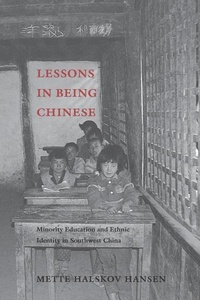
Lessons in Being Chinese
Minority Education and Ethnic Identity in Southwest China
Published on 1. August 1999
Book
Paperback/Softback
248 pages
978-0-295-97788-1 (ISBN)
Description
Open-access edition: DOI 10.6069/9780295804125
Two very different ethnic minority communities-the Naxi of the Lijiang area in northern Yunnan and the Tai (Dai) of Sipsong Panna (Xishuangbanna), along Yunnan's border with Burma and Laos-are featured in this comparative study of the implementation and reception of state minority education policy in the People's Republic of China. Based on field research and historical sources, Lessons in Being Chinese argues that state policy, which is intended to be applied uniformly across all minority regions, in fact is much more successful in some than in others.
In Lijiang, elite members of the Naxi ethnic group (minzu) have a centuries-old connection with Chinese state educational systems as avenues to social mobility, and have continued this tradition under Communist rule. They participate enthusiastically in the present system, using education to gain official and professional positions. In contrast to the Lijiang area, Sipsong Panna functioned in many ways as a separate kingdom until 1950, with its own script and a separate educational system centered in Theravada Buddhist monasteries. Today, many Tai in that area still prefer monastic education for their sons, and most parents are indifferent to state education.
This study finds that standardized, homogenizing state education is in itself incapable of instilling in students an identification with the Chinese state, ironically often increasing ethnic identity. Lessons in Being Chinese enhances our understanding of how state policy toward minorities works in many areas of life, and its conclusions can be extended well beyond the sphere of education. It will be of interest to both anthropologists and educators.
Two very different ethnic minority communities-the Naxi of the Lijiang area in northern Yunnan and the Tai (Dai) of Sipsong Panna (Xishuangbanna), along Yunnan's border with Burma and Laos-are featured in this comparative study of the implementation and reception of state minority education policy in the People's Republic of China. Based on field research and historical sources, Lessons in Being Chinese argues that state policy, which is intended to be applied uniformly across all minority regions, in fact is much more successful in some than in others.
In Lijiang, elite members of the Naxi ethnic group (minzu) have a centuries-old connection with Chinese state educational systems as avenues to social mobility, and have continued this tradition under Communist rule. They participate enthusiastically in the present system, using education to gain official and professional positions. In contrast to the Lijiang area, Sipsong Panna functioned in many ways as a separate kingdom until 1950, with its own script and a separate educational system centered in Theravada Buddhist monasteries. Today, many Tai in that area still prefer monastic education for their sons, and most parents are indifferent to state education.
This study finds that standardized, homogenizing state education is in itself incapable of instilling in students an identification with the Chinese state, ironically often increasing ethnic identity. Lessons in Being Chinese enhances our understanding of how state policy toward minorities works in many areas of life, and its conclusions can be extended well beyond the sphere of education. It will be of interest to both anthropologists and educators.
Reviews / Votes
"This is a critical as well as comprehensive study of minority education and ethnic identity in a southwest province of China: the Yunnan province. . . . This is a very informative work and a very substantial piece of research on minority education in China. It is a must read for people who want to know about the details, the intricacies, and the hidden agendas of education for minorities in China."(Journal of Asian and African Studies) "This book is especially relevant in these times when assimiliationist educational projects in minority communities are debated as human-rights issues in countries as different as Canada and Taiwan. [Hansen] provides much-needed discussion and empirical data on these issues in a fascinating province of the People's Republic of China."
(China Review International)
More details
Series
Language
English
Place of publication
Seattle
United States
Target group
Professional and scholarly
Product notice
Paperback (trade)
Illustrations
12 photos
Dimensions
Height: 230 mm
Width: 154 mm
Thickness: 16 mm
Weight
349 gr
ISBN-13
978-0-295-97788-1 (9780295977881)
Copyright in bibliographic data and cover images is held by Nielsen Book Services Limited or by the publishers or by their respective licensors: all rights reserved.
Schweitzer Classification
Other editions
Additional editions
Mette Halskov Hansen
Lessons in Being Chinese
Minority Education and Ethnic Identity in Southwest China
E-Book
10/2011
University of Washington Press
€0.00
Available for download
Previous edition

Mette Halskov Hansen
Lessons in Being Chinese
Minority Education and Ethnic Identity in Southwest China
Book
08/1999
University of Washington Press
€45.99
Article exhausted; check for reprint
Person
Mette Halskov Hansen
Content
Acknowledgments
Map 1: Yunnan Province
Map 2: Sipsong Panna Tai (Dai) Autonomous Prefecture
Introduction
1. Education and Chinese Minority Policy
2. History of Chinese Education among the Naxi in Lijiang
3. Education and Ethnic Identity in Lijiang since 1980
4. History of Chinese Education in sipsong Panna
5. Education and Ethnic Identity is Sipsong Panna since 1980
Conclusion
Chinese Character Glossary
Bibliography
Index
Map 1: Yunnan Province
Map 2: Sipsong Panna Tai (Dai) Autonomous Prefecture
Introduction
1. Education and Chinese Minority Policy
2. History of Chinese Education among the Naxi in Lijiang
3. Education and Ethnic Identity in Lijiang since 1980
4. History of Chinese Education in sipsong Panna
5. Education and Ethnic Identity is Sipsong Panna since 1980
Conclusion
Chinese Character Glossary
Bibliography
Index