

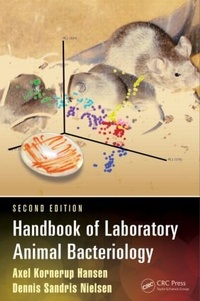
Handbook of Laboratory Animal Bacteriology
2nd Edition
Published on 11. November 2014
Book
Hardback
300 pages
978-1-4822-1544-1 (ISBN)
Description
The Handbook of Laboratory Animal Bacteriology, Second Edition provides comprehensive information on all bacterial phylae found in laboratory rodents and rabbits to assist managers, veterinary pathologists and laboratory animal veterinarians in the management of these organisms. The book starts by examining the general aspects of bacteriology and how to sample and identify bacteria in animals. It then describes the most relevant species within each phylum and discusses the impact they may have on research. Emphasizing those bacteria known to interfere with research protocols, the book offers methods for isolation and differentiation among related bacteria. It discusses where to purchase reagents for rodent bacteriology and outlines standards for safety in a bacteriological laboratory.
Highlights of the second edition:
Focuses on modern sequencing techniques based on molecular identification
Reorganizes content according to modern systematics based on new identification methods
Presents new chapters on mechanisms behind bacterial impact on animal models and on the systematic classification of bacteria
Provides information on a range of bacteria interfering with animal models for human disease, not only for those bacteria which cause disease in laboratory animal colonies
Includes new figures in color and with enhanced resolution
The book is essential reading for those interested in the management of organisms known to interfere with the colony health of rabbits and rodents used in research protocols-including facility managers, clinical veterinarians, veterinary pathologists, and researchers.
Highlights of the second edition:
Focuses on modern sequencing techniques based on molecular identification
Reorganizes content according to modern systematics based on new identification methods
Presents new chapters on mechanisms behind bacterial impact on animal models and on the systematic classification of bacteria
Provides information on a range of bacteria interfering with animal models for human disease, not only for those bacteria which cause disease in laboratory animal colonies
Includes new figures in color and with enhanced resolution
The book is essential reading for those interested in the management of organisms known to interfere with the colony health of rabbits and rodents used in research protocols-including facility managers, clinical veterinarians, veterinary pathologists, and researchers.
Reviews / Votes
"This text...provides updated information on new technologies commonly used in bacteriology, including standard molecular biologic techniques. Additionally, unlike the original edition, the authors provide commentary on how bacteria affect and can interfere with research animal models. The perspective of bacteriologists about the progress and new horizons for the field of bacteriology is well-written and will likely prove interesting to laboratory animal professionals. Chapters 2-6...are also valuable reference material to laboratory animal professionals designing health programs, diagnosing clinical or subclinical disease, or investigating changes in research animal models."-Melissa C. Dyson, DVM, MS, DACLAM, University of Michigan, in Laboratory Animal Practitioner
"Colony managers, veterinary pathologists, and veterinarians will find this comprehensive guide to the bacterial phyla found in laboratory animals useful. Beginning with an introduction to bacteriology and sampling techniques, the bulk of the book focuses on describing the most common bacteria in animals with a specific focus on the bacteria that will interfere with research protocols. Included are details on differentiating between related bacteria, rodent bacteriology reagents and safety issues. The second edition has a new focus on sequencing technique and is reorganized to reflect the most up to date identification methods."
-Ringgold, Inc. Book News, February 2015
Praise for the First Edition"...this book provides precise methodology for the isolation and identification of bacteria that interfere with research protocols. It is logically organized, instructive, and progresses through animal sampling, bacterial culture, isolation, differentiation, and identification... . The book is a valuable guide to the bacteriological monitoring of rodent and rabbit research animal colonies... . It should be useful to laboratory animal health monitoring laboratories and to those needing overall information on how to perform laboratory animal bacteriological procedures. It will also be of interest to facility managers, clinical veterinarians, veterinary pathologists, and researchers interested in the management of organisms known to interfere with the colony health of rabbits and rodents used in research protocols."
-Contemporary Topics in Laboratory Animal Science, March 2000
More details
Edition
2nd edition
Language
English
Place of publication
Bosa Roca
United States
Publishing group
Taylor & Francis Inc
Target group
College/higher education
Professional and scholarly
Professional Reference
Illustrations
8 farbige Abbildungen, 78 s/w Tabellen, 58 s/w Abbildungen
78 Tables, black and white; 8 Illustrations, color; 58 Illustrations, black and white
Dimensions
Height: 234 mm
Width: 156 mm
Weight
560 gr
ISBN-13
978-1-4822-1544-1 (9781482215441)
Copyright in bibliographic data and cover images is held by Nielsen Book Services Limited or by the publishers or by their respective licensors: all rights reserved.
Schweitzer Classification
Other editions
Additional editions
Axel Kornerup Hansen | Dennis Sandris Nielsen
Handbook of Laboratory Animal Bacteriology
Book
09/2020
2nd Edition
CRC Press
€73.80
Shipment within 15-20 days
Axel Kornerup Hansen | Dennis Sandris Nielsen
Handbook of Laboratory Animal Bacteriology
E-Book
11/2014
2nd Edition
CRC Press
€67.49
Available for download
Axel Kornerup Hansen | Dennis Sandris Nielsen
Handbook of Laboratory Animal Bacteriology
E-Book
11/2014
2nd Edition
CRC Press
€67.49
Available for download
Previous edition
Axel K. Hansen
Handbook of Laboratory Animal Bacteriology
Book
08/1999
1st Edition
CRC Press
€158.46
Article exhausted; check for reprint
Persons
Axel Kornerup Hansen (DVM, Dr. Vet. Sci., DipECLAM) is professor in laboratory animal science and welfare at University of Copenhagen. He is heading a research group mainly focusing on how the microbiota has an impact on laboratory animal models for inflammatory diseases and how this works in conjunction with the diet. He has published 157 peer-reviewed papers in scientific journals, and 36 other papers in books, proceedings or popular journals.
Dennis Sandris Nielsen (MSc, PhD) is associate professor at University of Copenhagen, with a special interest in gut microbiota, indigenous African fermented foods and fermented products contributing to the more joyful side of life (cocoa, wine, coffee). He is heading a research group mainly focusing on microbe-host and microbe-microbe-interactions in the mammalian gastrointestinal tract. He has published 75 peer-reviewed papers in scientific journals, and 15+ other papers in books, proceedings or popular journals.
Dennis Sandris Nielsen (MSc, PhD) is associate professor at University of Copenhagen, with a special interest in gut microbiota, indigenous African fermented foods and fermented products contributing to the more joyful side of life (cocoa, wine, coffee). He is heading a research group mainly focusing on microbe-host and microbe-microbe-interactions in the mammalian gastrointestinal tract. He has published 75 peer-reviewed papers in scientific journals, and 15+ other papers in books, proceedings or popular journals.
Content
Laboratory animal bacteriology: The past, the present, and the future. Sampling animals for bacteriological examination. Cultivation and identification of bacteria. Immunological methods. Molecular biology-based methods for microbiota characterization. Mechanisms behind bacterial impact on animal models Systematic classification of bacteria. Firmicutes. Bacteroidetes. Proteobacteria. Actinobacteria. Spirochaetae. Tenericutes. Verrucomicrobia, Deferribacteres, Fusobacterium, and TM. Appendix A: Producers of reagents for laboratory animal bacteriology. Appendix B: Biosafety levels for microbiological laboratories. Appendix C: Media buffers and reagents commonly applied in. laboratory animal bacteriology. Index.