

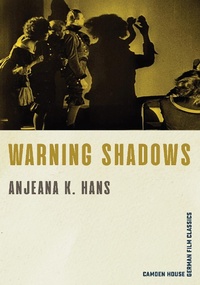
Warning Shadows
Published on 15. September 2021
Book
Paperback/Softback
102 pages
978-1-64014-091-2 (ISBN)
Description
A view of a long-neglected classic of Weimar cinema - now restored and widely available - as both a gripping narrative of infidelity and jealousy and a film inherently about film.
Artur Robison's Warning Shadows - in German simply Schatten, shadows - premiered in 1923 to critical acclaim. This story of a fateful dinner party at which a flirtatious wife, her jealous husband, and their guests are entertained by a traveling illusionist who deals in shadow play and hypnosis was extolled by one critic as superior to Wegener's Golem, Lubitsch's Passion, even Murnau's Nosferatu and Wiene's The Cabinet of Dr. Caligari. Yet where those films became mainstays of film history, Warning Shadows was long unknown: only recently, with the release of a restored version on DVD, has it begun to get its due. One of the few silent movies to eschew intertitles, it was an attempt to create a "pure film," drawing on the qualities of cinema that made it not an heir to literature or theater but a unique and autonomous art form. Staging a story of desire, adultery, and violence, Robison's film also engaged with discourses at the heart of Weimar culture, from changing gender norms to hysteria and hypnosis to the construction of spectatorship. Seen this way, Warning Shadows is both a gripping narrative of infidelity and jealousy and a film inherently about film.
Artur Robison's Warning Shadows - in German simply Schatten, shadows - premiered in 1923 to critical acclaim. This story of a fateful dinner party at which a flirtatious wife, her jealous husband, and their guests are entertained by a traveling illusionist who deals in shadow play and hypnosis was extolled by one critic as superior to Wegener's Golem, Lubitsch's Passion, even Murnau's Nosferatu and Wiene's The Cabinet of Dr. Caligari. Yet where those films became mainstays of film history, Warning Shadows was long unknown: only recently, with the release of a restored version on DVD, has it begun to get its due. One of the few silent movies to eschew intertitles, it was an attempt to create a "pure film," drawing on the qualities of cinema that made it not an heir to literature or theater but a unique and autonomous art form. Staging a story of desire, adultery, and violence, Robison's film also engaged with discourses at the heart of Weimar culture, from changing gender norms to hysteria and hypnosis to the construction of spectatorship. Seen this way, Warning Shadows is both a gripping narrative of infidelity and jealousy and a film inherently about film.
Reviews / Votes
Hans works knowledgeably through the production and performance history of Artur Robison's hallucinatory chamber-play (Kammerspiel) fantasy, which dispenses entirely with intertitles. ...She illuminates the historical and cultural contexts in which the specific aesthetic configuration of the relationship between cinematic-scenic representation and a viewer oscillating between detachment and affect can be located * FILMBLATT *More details
Series
Language
English
Place of publication
Columbia, MD
United States
Publishing group
Boydell & Brewer Ltd
Target group
Professional and scholarly
Product notice
Paperback (trade)
Illustrations
31 colour and 2 b/w illus.
Dimensions
Height: 188 mm
Width: 132 mm
Thickness: 10 mm
Weight
204 gr
ISBN-13
978-1-64014-091-2 (9781640140912)
Copyright in bibliographic data and cover images is held by Nielsen Book Services Limited or by the publishers or by their respective licensors: all rights reserved.
Schweitzer Classification
Other editions
Additional editions
Anjeana K. Hans
Warning Shadows
E-Book
09/2021
1st Edition
Boydell & Brewer
€14.99
Available for download
Anjeana K. Hans
Warning Shadows
E-Book
09/2021
1st Edition
Boydell & Brewer
€14.99
Available for download
Person
Content
Introduction: A Little-Known Movie
The Making of the Movie
Defining Film: Art Form or Public Danger?
A Film "Full of Eroticism"
Projections within Projections
The Illusionist: Magic, Control, and Art
Spectators Become Actors
Hypnotism: Therapy and Spectacle
"This Magical Therapy"
What Lies Beneath: Gender and Violence
The Hypnotic Screen
The Other Projection: The Chinese Shadow Play
Conclusion: A More Complex History
Credits
Notes
The Making of the Movie
Defining Film: Art Form or Public Danger?
A Film "Full of Eroticism"
Projections within Projections
The Illusionist: Magic, Control, and Art
Spectators Become Actors
Hypnotism: Therapy and Spectacle
"This Magical Therapy"
What Lies Beneath: Gender and Violence
The Hypnotic Screen
The Other Projection: The Chinese Shadow Play
Conclusion: A More Complex History
Credits
Notes