

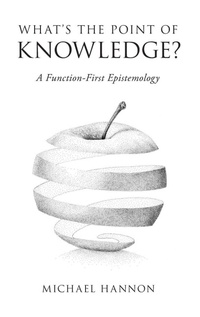
What's the Point of Knowledge?
A Function-First Epistemology
Published on 21. February 2019
Book
Hardback
288 pages
978-0-19-091472-1 (ISBN)
Description
This book is about knowledge and its value. At its heart is a straightforward idea: we can answer many interesting and difficult questions in epistemology by reflecting on the role of epistemic evaluation in human life. Michael Hannon calls this approach function-first epistemology.
To Hannon, the concept of knowledge is used to identify reliable informants; this practice is necessary, or at least deeply important, because it plays a vital role in human survival, cooperation, and flourishing.
Though a seemingly simple idea, function-first epistemology has wide-reaching implications. From this premise, Hannon casts new light on the very nature and value of knowledge, the differences between knowledge and understanding, the relationship between knowledge, assertion, and practical reasoning, and the semantics of knowledge claims.
This book forges new paths into some classic philosophical puzzles, including the Gettier problem, epistemic relativism, and philosophical skepticism. What's the Point of Knowledge? shows that pivotal issues in epistemology can be resolved by taking a function-first approach, demonstrating the significant role that this method can play in contemporary philosophy.
To Hannon, the concept of knowledge is used to identify reliable informants; this practice is necessary, or at least deeply important, because it plays a vital role in human survival, cooperation, and flourishing.
Though a seemingly simple idea, function-first epistemology has wide-reaching implications. From this premise, Hannon casts new light on the very nature and value of knowledge, the differences between knowledge and understanding, the relationship between knowledge, assertion, and practical reasoning, and the semantics of knowledge claims.
This book forges new paths into some classic philosophical puzzles, including the Gettier problem, epistemic relativism, and philosophical skepticism. What's the Point of Knowledge? shows that pivotal issues in epistemology can be resolved by taking a function-first approach, demonstrating the significant role that this method can play in contemporary philosophy.
Reviews / Votes
Recommended. * N.D. Smith, CHOICE * This book presents a radical and promising reconception of the nature and function of knowledge. * Catherine Z. Elgin, Professor of the Philosophy of Education, Harvard University * This book is a welcome addition to the literature on the nature of knowledge. Hannon approaches the topic by way asking about the point of epistemic evaluation; his 'function-first' account goes on to develop Edward Craig's idea that the point of knowledge ascriptions is to identify good informants. Hannon contends that this approach affords a greater payoff than has been recognized, and his argument for this should be of great interest to epistemologists. * Sanford C. Goldberg, Professor of Philosophy, Northwestern University * What's the Point of Knowledge? does a splendid job of setting out in detail what a Craig-style function-first approach to the theory of knowledge would look like. This monograph will be of tremendous interest to anyone working in contemporary epistemology. * Duncan Pritchard, Chancellor's Professor of Philosophy, UC Irvine, and Professor of Philosophy, University of Edinburgh * This is an excellent work. Michael Hannon very helpfully and sensitively unpacks the function-first methodology, including what Edward Craig has said on the matter. This is not, however, a re-hashing of Craig's views: Hannon develops his ideas in philosophically independent ways. Chapters individually and cumulatively are very impressive, covering a wide range of topics. They do not neglect any significant position, and respond to a truly impressive sample of contributors. Hannon is a clear and powerful thinker. I recommend this book highly. * David Henderson, Professor of Philosophy, University of Nebraska-Lincoln *More details
Language
English
Place of publication
New York
United States
Target group
Professional and scholarly
Dimensions
Height: 240 mm
Width: 161 mm
Thickness: 20 mm
Weight
596 gr
ISBN-13
978-0-19-091472-1 (9780190914721)
Copyright in bibliographic data and cover images is held by Nielsen Book Services Limited or by the publishers or by their respective licensors: all rights reserved.
Schweitzer Classification
Other editions
Additional editions
E-Book
12/2018
OUP eBook
€52.49
Available for download
E-Book
12/2018
OUP eBook
€40.49
Available for download
Person
Michael Hannon is an Assistant Professor of Philosophy at the University of Nottingham. After receiving his PhD from the University of Cambridge, he served as Deputy Director of the Institute of Philosophy at the University of London. His research in epistemology covers topics such as skepticism, fallibilism, the value of knowledge, and the role of truth in politics. He founded the Political Epistemology Network and holds a British Academy Rising Star Engagement Award for his project on political epistemology.
Content
Introduction
Chapter 1. Methodologies in Epistemology
Chapter 2. The Point of Knowledge
Chapter 3. The Value of Fallible Knowledge
Chapter 4. Impure Knowledge
Chapter 5. Pluralism about Knowledge
Chapter 6. Epistemic Diversity
Chapter 7. Epistemic Pragmatism
Chapter 8. Skepticism and the Point of Knowledge
Chapter 9. What's the Point of Understanding?
Bibliography
Chapter 1. Methodologies in Epistemology
Chapter 2. The Point of Knowledge
Chapter 3. The Value of Fallible Knowledge
Chapter 4. Impure Knowledge
Chapter 5. Pluralism about Knowledge
Chapter 6. Epistemic Diversity
Chapter 7. Epistemic Pragmatism
Chapter 8. Skepticism and the Point of Knowledge
Chapter 9. What's the Point of Understanding?
Bibliography