

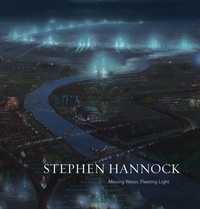
Stephen Hannock
Moving Water, Fleeting Light
Will be published approx. on 29. October 2026
Book
Hardback
240 pages
978-1-7329864-7-3 (ISBN)
Description
Coinciding with Stephen Hannock's return to phosphorescent painting, this monograph demonstrates the artist's appreciation for, and willingness to move beyond, traditional landscape artists.
Known for his atmospheric landscapes-flooded rivers, incendiary nocturnes, and expansive vistas-Stephen Hannock's works demonstrate his keen appreciation for the quality of light that recalls the Hudson River School and the Luminist painters. While his subject matter is initially reminiscent of Europeans Caspar David Friedrich and JMW Turner, and Americans Thomas Cole and Frederic Edwin Church, Hannock moves beyond the influence of traditional landscape artists to create works that have been described as self-portraiture.
Characterizing his work as a reinvention of familiar vistas, Hannock focuses on setting the stage for stories that he writes onto the surface of the piece. His unique process of layering paint and then polishing the surface achieves an ethereal luminosity. His remarkable murals, some dating back to the 1970s, further explore his interest in setting the stage for storytelling. This newest study, with its highest-quality reproductions, affords readers the opportunity to revisit familiar works included in Hannock's first monograph, published in 2009, as they appreciate his newest paintings that showcase his evolving techniques, expanding subject matter, and the return to his pioneering use of phosphorescent pigments illuminated under black light.
Known for his atmospheric landscapes-flooded rivers, incendiary nocturnes, and expansive vistas-Stephen Hannock's works demonstrate his keen appreciation for the quality of light that recalls the Hudson River School and the Luminist painters. While his subject matter is initially reminiscent of Europeans Caspar David Friedrich and JMW Turner, and Americans Thomas Cole and Frederic Edwin Church, Hannock moves beyond the influence of traditional landscape artists to create works that have been described as self-portraiture.
Characterizing his work as a reinvention of familiar vistas, Hannock focuses on setting the stage for stories that he writes onto the surface of the piece. His unique process of layering paint and then polishing the surface achieves an ethereal luminosity. His remarkable murals, some dating back to the 1970s, further explore his interest in setting the stage for storytelling. This newest study, with its highest-quality reproductions, affords readers the opportunity to revisit familiar works included in Hannock's first monograph, published in 2009, as they appreciate his newest paintings that showcase his evolving techniques, expanding subject matter, and the return to his pioneering use of phosphorescent pigments illuminated under black light.
More details
Language
English
Place of publication
New York
United States
Product notice
Cloth over boards
Illustrations
200 color plates
Dimensions
Height: 279 mm
Width: 292 mm
ISBN-13
978-1-7329864-7-3 (9781732986473)
Copyright in bibliographic data and cover images is held by Nielsen Book Services Limited or by the publishers or by their respective licensors: all rights reserved.
Schweitzer Classification
Persons
Stephen Hannock attended Bowdoin College before studying at Smith and Hampshire Colleges. While at Smith, he was apprenticed to renowned artist Leonard Baskin, and he was also guided by groundbreaking art historians Betty and Agnes Mongan. In 1999, Hannock's paintings for the movie What Dreams May Come won the Academy Award for "Special Visual Effects."
Hannock's work can be found in public collections throughout the United States, including The Metropolitan Museum of Art, New York; The National Gallery of Art, Washington, DC; The Whitney Museum of American Art, New York; The Boston Museum of Fine Arts; The Museum of Contemporary Art, San Diego, California; The Museum of Fine Arts, Houston, Texas; and the Yale University Art Gallery, New Haven, Connecticut, along with numerous other public and private collections.
Henry Adams is the Ruth Coulter Heede Professor of Art History at Case Western Reserve University. The author of over 400 publications in the field of American art history, he has been a curator at many institutions including the Nelson-Atkins Museum of Art and the Cleveland Museum of Art. He is a graduate of Harvard University and received his MA and PhD from Yale University, where he received the Frances Blanshard prize for the best doctoral dissertation in art history. Most recently, he received the Baker Nord Award for the Humanities bestowed on the most outstanding scholar in the Humanities at Case Western Reserve University.
Jason Rosenfeld has been a professor of art history at Marymount Manhattan College since 2003. He has written extensively on contemporary art and issues in figuration and landscape, art and architecture in New York City, nineteenth-century European art, British Victorian and Pre-Raphaelite art, and modern architecture. He received his BA from Duke University and his MA and PhD from the Institute of Fine Arts, New York University. He has previously taught at Assumption College in Worcester, Massachusetts; New York University; and Queens College, City University of New York.
Elisabeth Hodermarsky is the Sutphin Family Curator of Prints and Drawings at Yale University Art Gallery and a contributing author to John La Farge's Second Paradise: Voyages in the South Seas, 1890-1891. Hodermarsky's curatorial work focuses on prints and drawings, with a strong emphasis on American and international art from the 19th and 20th centuries. Her career reflects a blend of curatorial leadership, scholarly research, and exhibition curation.
Veronique Plesch is chair of the art department at Colby College. She holds advanced degrees in art history and medieval French literature from University of Geneva and a PhD in art history from Princeton University. Fluent in English, French, Italian, and Spanish, her area of expertise ranges from late medieval and Renaissance iconography, to Alpine art, and from Passion plays to early modern graffiti, with forays into contemporary art-many of them with a focus on word and image issues.
Hannock's work can be found in public collections throughout the United States, including The Metropolitan Museum of Art, New York; The National Gallery of Art, Washington, DC; The Whitney Museum of American Art, New York; The Boston Museum of Fine Arts; The Museum of Contemporary Art, San Diego, California; The Museum of Fine Arts, Houston, Texas; and the Yale University Art Gallery, New Haven, Connecticut, along with numerous other public and private collections.
Henry Adams is the Ruth Coulter Heede Professor of Art History at Case Western Reserve University. The author of over 400 publications in the field of American art history, he has been a curator at many institutions including the Nelson-Atkins Museum of Art and the Cleveland Museum of Art. He is a graduate of Harvard University and received his MA and PhD from Yale University, where he received the Frances Blanshard prize for the best doctoral dissertation in art history. Most recently, he received the Baker Nord Award for the Humanities bestowed on the most outstanding scholar in the Humanities at Case Western Reserve University.
Jason Rosenfeld has been a professor of art history at Marymount Manhattan College since 2003. He has written extensively on contemporary art and issues in figuration and landscape, art and architecture in New York City, nineteenth-century European art, British Victorian and Pre-Raphaelite art, and modern architecture. He received his BA from Duke University and his MA and PhD from the Institute of Fine Arts, New York University. He has previously taught at Assumption College in Worcester, Massachusetts; New York University; and Queens College, City University of New York.
Elisabeth Hodermarsky is the Sutphin Family Curator of Prints and Drawings at Yale University Art Gallery and a contributing author to John La Farge's Second Paradise: Voyages in the South Seas, 1890-1891. Hodermarsky's curatorial work focuses on prints and drawings, with a strong emphasis on American and international art from the 19th and 20th centuries. Her career reflects a blend of curatorial leadership, scholarly research, and exhibition curation.
Veronique Plesch is chair of the art department at Colby College. She holds advanced degrees in art history and medieval French literature from University of Geneva and a PhD in art history from Princeton University. Fluent in English, French, Italian, and Spanish, her area of expertise ranges from late medieval and Renaissance iconography, to Alpine art, and from Passion plays to early modern graffiti, with forays into contemporary art-many of them with a focus on word and image issues.