

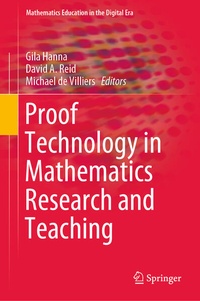
Proof Technology in Mathematics Research and Teaching
Published on 18. October 2019
Book
Hardback
VIII, 379 pages
978-3-030-28482-4 (ISBN)
Description
Provides a much needed update on new developments on proof in the digital era Brings new ideas on teaching proof and proving in mathematics education Emphasizes interdisciplinary approaches on education, philosophy and technology
Reviews / Votes
"This book is intended for specialists in mathematics education with an interest in computer science advances as well as for researchers in the field of automated reasoning with an interest in the pedagogical and didactic implications of their work. It provides a valuable contribution to mathematics education by initiating a process of in-depth reflection on the educational value of new technological tools such as automatic theorem provers and dynamic geometric environments." (Frédéric Morneau-Guérin, MAA Reviews, May 24, 2020)
More details
Series
Edition
2019 ed.
Language
English
Place of publication
Cham
Switzerland
Publishing group
Springer International Publishing
Target group
Professional and scholarly
Illustrations
83 farbige Abbildungen, 54 s/w Abbildungen
VIII, 379 p. 137 illus., 83 illus. in color.
Dimensions
Height: 241 mm
Width: 160 mm
Thickness: 26 mm
Weight
817 gr
ISBN-13
978-3-030-28482-4 (9783030284824)
DOI
10.1007/978-3-030-28483-1
Schweitzer Classification
Other editions
Additional editions
Gila Hanna | David A. Reid | Michael de Villiers
Proof Technology in Mathematics Research and Teaching
Book
10/2020
Springer
€160.49
Shipment within 7-9 days
Gila Hanna | David A. Reid | Michael de Villiers
Proof Technology in Mathematics Research and Teaching
E-Book
10/2019
1st Edition
Springer
€149.79
Available for download
Content
Chapter 1. Proof technology: Implications for teaching.- Chapter 2. A fully automatic theorem prover with human-style output.- Chapter 3. A common type of rigorous proof that resists Hilbert's programme.- Chapter 4. SMTCoq: Mixing automatic and interactive proof technologies.- Chapter 5. Studying algebraic structures using Prover9 and Mace4.- Chapter 6. Didactical issues at the interface of mathematics and computer science.- Chapter 7. Issues and challenges in instrumental proof.- Chapter 8. Reasoning by equivalence: the potential contribution of an automatic proof checker.- Chapter 9. Virtual manipulatives and students' counterexamples during proving.- Chapter 10. Proof technology and learning in mathematics: Common issues and perspectives.