

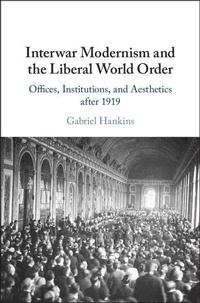
Interwar Modernism and the Liberal World Order
Offices, Institutions, and Aesthetics after 1919
Published on 29. August 2019
Book
Hardback
228 pages
978-1-108-49456-4 (ISBN)
Description
What was the modernist response to the global crisis of liberal world order after 1919? This book tells the story of the origins of liberal world governance in Cambridge modernist circles, the literary response to the Versailles Peace of 1919, and the contestation of that institutional moment across a range of world literary modernities. Challenging standard accounts of reactionary postwar politics, Interwar Modernism and the Liberal World Order articulates a modernism animated by the contradictions of liberal governance between the wars. The book develops a new materialist reading of modernist politics hinged on the official figures that traverse both modernist texts and liberal order. This official liberal world shapes interwar arts and letters from wartime Cambridge to revolutionary Shanghai.
More details
Language
English
Place of publication
Cambridge
United Kingdom
Target group
Professional and scholarly
Product notice
Laminated cover
Illustrations
Worked examples or Exercises
Dimensions
Height: 235 mm
Width: 157 mm
Thickness: 17 mm
Weight
490 gr
ISBN-13
978-1-108-49456-4 (9781108494564)
Copyright in bibliographic data and cover images is held by Nielsen Book Services Limited or by the publishers or by their respective licensors: all rights reserved.
Schweitzer Classification
Other editions
Additional editions
Gabriel Hankins
Interwar Modernism and the Liberal World Order
Offices, Institutions, and Aesthetics after 1919
E-Book
08/2019
Cambridge University Press
€111.99
Available for download
Gabriel Hankins
Interwar Modernism and the Liberal World Order
Offices, Institutions, and Aesthetics after 1919
E-Book
08/2019
Cambridge University Press
€73.99
Available for download
Person
Gabriel Hankins is Assistant Professor of English at Clemson University, South Carolina. He directs the Twentieth-Century Literary Letters Project, and writes on literary history, theory, digital method, correspondence, and color.
Content
1. The queer modernist origins of interwar liberal order; 2. Friends and enemies: liberal order in Woolf, Wells, and Woolf; 3. The artist as clerk: debt, paperwork, and liberal order in T. S. Eliot; 4. Typewriter fiction at the secretariat; 5. Black modernist internationalisms between the wars: Rene Maran, W. E. B. Du Bois, Jessie Fauset, and Claude McKay.