

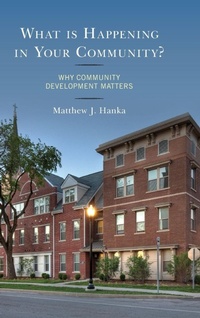
What is Happening in Your Community?
Why Community Development Matters
Published on 3. May 2021
Book
Hardback
338 pages
978-1-4985-0491-1 (ISBN)
Description
Communities are not static or stationary organisms. They are fluid and dynamic and change over time. The role of community development in the change and transformation of a community is critical to improving and enhancing the quality of life of the community and its residents. This book examines how community development changes a community and why that change matters, while also examining the relationship between community development and social capital. When a community improves its social capital, change can happen because people can leverage their networks to produce better results for themselves. This book also looks at comprehensive community development and collective impact models and several case studies that utilize these models. It also looks at how the transformation and revitalization of a neighborhood through new housing creates opportunities for people everywhere, and how effective placemaking strategies empower diverse groups of people in a community to reimagine their public spaces and the built environment to be more livable, walkable, creative, and sustainable while fostering greater connections with people in their community.
More details
Language
English
Place of publication
United States
Publishing group
Bloomsbury Publishing Plc
Target group
Professional and scholarly
Illustrations
18 b/w photos; 10 tables;
Dimensions
Height: 235 mm
Width: 157 mm
Thickness: 23 mm
Weight
641 gr
ISBN-13
978-1-4985-0491-1 (9781498504911)
Copyright in bibliographic data and cover images is held by Nielsen Book Services Limited or by the publishers or by their respective licensors: all rights reserved.
Schweitzer Classification
Other editions
Additional editions
E-Book
05/2021
1st Edition
Lexington Books
€37.49
Available for download
Persons
Matthew J. Hanka is associate professor of political science at the University of Southern Indiana.
Content
Introduction
Chapter 1: What is Community? What is Community Development? History of Community Development; Models of Community Development
Chapter 2: Social Capital: Dimensions of Social Capital, Social Networks, Critiques of Social Capital
Chapter 3: The Social Capital Implications of Habitat for Humanity Homeownership
Matthew J. Hanka, Mohammed Khayum and Ramona Harvey
Chapter 4: Social Capital and Economic Development: A Neighborhood Perspective
Matthew J. Hanka and Trent Engbers
Chapter 5: Service Learning and Community Development
Anne Statham and Helen Rosenberg
Chapter 6: Adaptive Collaborative Community Transformation (ACCT) model of Comprehensive Community Development and Case Studies: Glenwood, Jacobsville, and Engage Henderson
Chapter 7: What is Collective Impact? Case Studies of Collective Impact: VOICE and Promise Zone
Chapter 8: HOPE VI, New Urbanism, and Social Capital
Matthew J. Hanka and John Gilderbloom
Chapter 9: Placemaking and Social Capital
Conclusion: Lessons learned
Chapter 1: What is Community? What is Community Development? History of Community Development; Models of Community Development
Chapter 2: Social Capital: Dimensions of Social Capital, Social Networks, Critiques of Social Capital
Chapter 3: The Social Capital Implications of Habitat for Humanity Homeownership
Matthew J. Hanka, Mohammed Khayum and Ramona Harvey
Chapter 4: Social Capital and Economic Development: A Neighborhood Perspective
Matthew J. Hanka and Trent Engbers
Chapter 5: Service Learning and Community Development
Anne Statham and Helen Rosenberg
Chapter 6: Adaptive Collaborative Community Transformation (ACCT) model of Comprehensive Community Development and Case Studies: Glenwood, Jacobsville, and Engage Henderson
Chapter 7: What is Collective Impact? Case Studies of Collective Impact: VOICE and Promise Zone
Chapter 8: HOPE VI, New Urbanism, and Social Capital
Matthew J. Hanka and John Gilderbloom
Chapter 9: Placemaking and Social Capital
Conclusion: Lessons learned