

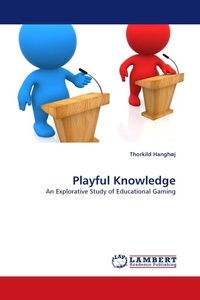
Playful Knowledge
An Explorative Study of Educational Gaming
Published on 16. February 2011
Book
Paperback/Softback
404 pages
978-3-8383-9381-0 (ISBN)
Description
It is often argued that games have great learning potential. However, there only exist few empirical studies that describe the "messy" reality of teaching and playing games within an educational context. In order to get a better understanding of the relationship between game design, game pedagogy and game interaction, this design-based study explores the design and use of an ICT-supported debate game entitled "The Power Game" for Danish upper secondary education, where students assume the roles as politicians, spin doctors, and journalists in order to win a parliamentary election. Based upon insights from pragmatism, interactionism and dialogism, a theoretical and analytical model is presented that describes educational gaming as a dynamic interplay between different knowledge aspects. Through an ethnographically inspired approach to discourse analysis, it is demonstrated how teachers and students that participate in "The Power Game" create playful and unpredictable tensions between different ways of enacting and validating knowledge. These tensions imply important consequences for the ways in which educational games can and should be designed, taught, and played.
More details
Language
English
Place of publication
Germany
Product notice
Paperback (trade)
Unsewn / adhesive bound
Dimensions
Height: 220 mm
Width: 150 mm
Thickness: 25 mm
Weight
620 gr
ISBN-13
978-3-8383-9381-0 (9783838393810)
Copyright in bibliographic data and cover images is held by Nielsen Book Services Limited or by the publishers or by their respective licensors: all rights reserved.
Schweitzer Classification
Persons
Thorkild Hanghøj (MSc in Cultural Studies, PhD) is an Assistant Professor at the Research Program for Media and ICT in a Learning Perspective at the Danish School of Education, University of Aarhus. His key field of research is the design and use of games in school contexts, especially in relation to game-based teacher roles.