

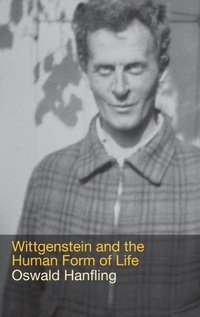
Wittgenstein and the Human Form of Life
1st Edition
Published on 22. August 2002
Book
Hardback
176 pages
978-0-415-25645-2 (ISBN)
Description
Wittgenstein's later writings generate a great deal of controversy and debate, as do the implications of his ideas for such topics as consciousness, knowledge, language and the arts.
Oswald Hanfling addresses a widespeard tendency to ascribe to Wittgenstein views that go beyond those he actually held. Separate chapters deal with important topics such as the private language argument, rule-following, the problem of other minds, and the ascription of scepticism to Wittgenstein. Describing Wittgenstein as a 'humanist' thinker, he contrasts his views on language, art humanity and philosophy itself with those of scientifically minded philosophers. He argues that 'the human form of life' calls for a kind of understanding that cfannot be achieved by the methods of emirical science; that consiousness, for example, cannot properly be regarded as a property of the bran; and that the resulting 'problem of consoiusness is an illusion.
Wittgenstein and the Human Form of Life is essential reading for anyone interested in Wittgenstein's approach to what it means to be human. It will be invaluable to all Wittgenstein scholars, and all who are interested in the philosophy of mind, language and aesthetics.
Oswald Hanfling addresses a widespeard tendency to ascribe to Wittgenstein views that go beyond those he actually held. Separate chapters deal with important topics such as the private language argument, rule-following, the problem of other minds, and the ascription of scepticism to Wittgenstein. Describing Wittgenstein as a 'humanist' thinker, he contrasts his views on language, art humanity and philosophy itself with those of scientifically minded philosophers. He argues that 'the human form of life' calls for a kind of understanding that cfannot be achieved by the methods of emirical science; that consiousness, for example, cannot properly be regarded as a property of the bran; and that the resulting 'problem of consoiusness is an illusion.
Wittgenstein and the Human Form of Life is essential reading for anyone interested in Wittgenstein's approach to what it means to be human. It will be invaluable to all Wittgenstein scholars, and all who are interested in the philosophy of mind, language and aesthetics.
More details
Language
English
Place of publication
London
United Kingdom
Publishing group
Taylor & Francis Ltd
Target group
College/higher education
Professional and scholarly
Postgraduate and Professional
Dimensions
Height: 240 mm
Width: 161 mm
Thickness: 14 mm
Weight
435 gr
ISBN-13
978-0-415-25645-2 (9780415256452)
Copyright in bibliographic data and cover images is held by Nielsen Book Services Limited or by the publishers or by their respective licensors: all rights reserved.
Schweitzer Classification
Other editions
Additional editions

Oswald Hanfling
Wittgenstein and the Human Form of Life
Book
10/2006
1st Edition
Routledge
€85.10
Shipment within 15-20 days
Oswald Hanfling
Wittgenstein and the Human Form of Life
E-Book
08/2003
Routledge
€79.49
Available for download
Oswald Hanfling
Wittgenstein and the Human Form of Life
E-Book
08/2003
Routledge
€79.49
Available for download
Person
Oswald Hanfling is a former Professor of Philosophy at the Open University. In addition to his many papers on Wittgenstein, he is the author of several books including Wittgenstein's Later Philosophy (1989) and Philosophy and Ordinary Language (Routledge, 2000).
Content
Introduction 1. Questions and answers in Wittgenstein's philosophy; 2. What does the Private Language Argument prove? 3. Criteria, Conventions and the problem of other minds 4. Does language need rules? 5. Wittgenstein on the use of 'I know' 6. Was Wittgenstein a sceptic? 7. Wittgenstein on language, art and humanity 8. Wittgenstein and the problem of consciousness 9. Could machines think? 10. Thinking 11. Secondary sense and 'what they have in common'