

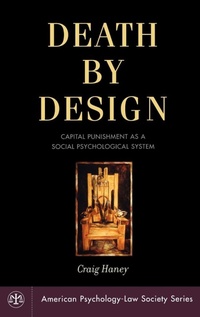
Death by Design
Capital Punishment As a Social Psychological System
Published on 25. August 2005
Book
Hardback
352 pages
978-0-19-518240-8 (ISBN)
Description
How can otherwise normal, moral persons - as citizens, voters, and jurors - participate in a process that is designed to take the life of another? In DEATH BY DESIGN, research psychologist Craig Haney argues that capital punishment, and particularly the sequence of events that lead to death sentencing itself, is maintained through a complex and elaborate social psychological system that distance and disengage us from the true nature of the task. Relying heavily on his own research and that of other social scientists, Haney suggests that these social psychological forces enable persons to engage in behavior from which many of them otherwise would refrain. However, by facilitating death sentencing in these ways, this inter-related set of social psychological forces also undermines the reliability and authenticity of the process, and compromises the fairness of its outcomes. Because these social psychological forces are systemic in nature - built into the very system of death sentencing itself - Haney concludes by suggesting a number of inter-locking reforms, derived directly from empirical research on capital punishment, that are needed to increase the fairness and reliability of the process.
The historic and ongoing public debate over the death penalty takes place not only in courtrooms, but also in classrooms, offices, and living rooms. This timely book offers stimulating insights into capital punishment for professionals and students working in psychology, law, criminology, sociology, and cultural area studies. As capital punishment receives continued attention in the media, it is also a necessary and provocative guide that empowers all readers to come to their own conclusions about the death penalty.
The historic and ongoing public debate over the death penalty takes place not only in courtrooms, but also in classrooms, offices, and living rooms. This timely book offers stimulating insights into capital punishment for professionals and students working in psychology, law, criminology, sociology, and cultural area studies. As capital punishment receives continued attention in the media, it is also a necessary and provocative guide that empowers all readers to come to their own conclusions about the death penalty.
Reviews / Votes
What Anthony Lewis's Gideon's Trumpet meant for understanding the right to counsel for the poor in this country, Dr. Haney's Death by Design means to understanding capital punishment in the United States. An astonishing synthesis of law, sociology, psychology, and the political history of capital punishment, Death by Design makes it possible for anyone to understand the death penalty in America in a deeply nuanced way. * Professor Andrea D. Lyon, Director, The Center for Justice in Capital Cases, DePaul College of Law * This eloquent yet fact-packed book does a superb job of making explicit the injustices and inhumane consequences of the use of the death penalty in America. * Jerome Bruner, University Professor, New York University School of Law * In this critical and engaging book, Craig Haney draws on an impressive body of empirical research, scientific analysis, and his own extensive experience to provide a crucial examination of the system of condemning people to death. His original perspective and outstanding writing make clear the flaws in the death penalty processes and the tragic and unfair results they produce. A groundbreaking study, Death by Design is sophisticated and compelling. It should be read not only by professionals and students, but also by anyone interested in the death penalty and human rights. * Stephen B. Bright, Director, Southern Center for Human Rights,Atlanta, Georgia * This important book documents how much America's passion for the death penalty is fueled by misunderstanding and misinformation about crime, criminals, and the administration of justice in capital cases. It exposes a complex web of mythology and mistake, rooted in sources from media hype to judicial hypocrisy, that distorts public debate about capital punishment, jury deliberations in capital sentencing trials, and judges' efforts to rationalize a runaway system. Must reading! * Anthony G. Amsterdam *More details
Series
Language
English
Place of publication
New York
United States
Target group
Professional and scholarly
Psychologists, legal professionals, and all forensic profssionals with an interest in the death penalty
Illustrations
2 halftones, numerous tables
Dimensions
Height: 240 mm
Width: 161 mm
Thickness: 23 mm
Weight
693 gr
ISBN-13
978-0-19-518240-8 (9780195182408)
Copyright in bibliographic data and cover images is held by Nielsen Book Services Limited or by the publishers or by their respective licensors: all rights reserved.
Schweitzer Classification
Other editions
Additional editions
E-Book
08/2005
1st Edition
OUP eBook
€40.99
Available for download
E-Book
08/2005
1st Edition
OUP eBook
€40.99
Available for download
Person
Craig Haney is a Professor of Psychology at the University of California, Santa Cruz. He has been collecting data on capital punishment for over 25 years.
Content
1. Blinded by the Death Penalty: The Supreme Court and the Social Realities of Capital Punishment ; 2. Frameworks of Misunderstanding: Capital Punishment and the American Media ; 3. Constructing Capital Crimes and Defendants: Death Penalty Case-Specific Biases and Their Effects ; 4. The Fragile Consensus: Public Opinion and The Death Penalty Policy ; 5. A Tribunal Organized to Convict and Execute?: On the Nature of Jury Selection in Capital Cases ; 6. Preparing for the Death Penalty in Advance of Trail: Process Effects in Death Qualifying Capital Juries ; 7. Structural Aggravation: Moral Disengagement in the Capital Trial Process ; 8. Misguided Discretion: Instructional Incomprehension in the System of Death Sentencing ; 9. Condemning the Other: Race, Mitigation, and the 'Empathic Divide' ; 10. No Longer Tinkering with the Machinery of Death: Proposals for Systemic Reform