

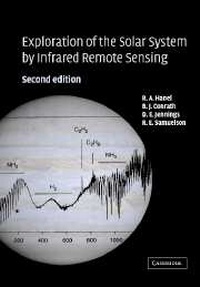
Exploration of the Solar System by Infrared Remote Sensing
2nd Edition
Published on 6. March 2003
Book
Hardback
534 pages
978-0-521-81897-1 (ISBN)
Description
This book describes all aspects of the theory, instrumental techniques and observational results of the remote sensing of objects in our Solar System through studies of infrared radiation. Fully revised since publication of the first edition in 1992, it now incorporates the latest technologies, new mission results and scientific discoveries. It also includes a fully up-dated bibliography to reflect the advances made in this field during the past ten years. All planets from Mercury to Pluto, many of their satellites, asteroids and comets are discussed. The presentation will appeal to advanced students and professional planetary science researchers, although some chapters are of wider interest. The authors have drawn on their extensive experience at the NASA-Goddard Space Flight Center to produce a definitive account of what can be learned from infrared studies of our planetary system.
Reviews / Votes
From review of the First Edition: 'Hanel and coauthors are among the foremost practitioners of infrared remote sensing as applied to planetary exploration. Highly recommended for libraries maintaining a research collection in comparative planetology or atmospheric physics.' F. R. Chromey, Choice 'Because Hanel and colleagues have (rightly) concentrated on the underlying fundamental principles, their discussion will provide a useful reference for years to come. This book is a valuable resource volume which many planetary scientists and advanced graduate students would find worth consulting.' Bruce Fegley, Jr , Geochimica Et Cosmochimica Acta '... presents an outstanding review and appraisal of the theory, instrumentation and interpretation of infrared planetary astronomy conducted mainly from spacecraft ... a lot of attention is directed toward spectroscopy, including some gorgeous Voyager emission spectra from the limb of Titan that show an exotic menagerie of hydrocarbons.' Joseph W. Chamberlain, American Scientist '... a valuable addition to the literature. As mentioned earlier, it would benefit a much wider readership than its title suggests.' Optics and Photonics News '... will appeal to advanced students and professional planetary science researchers.' The Strolling Astronomer: J.A.L.P.O.More details
Edition
2nd Revised edition
Language
English
Place of publication
Cambridge
United Kingdom
Target group
Professional and scholarly
Edition type
Revised edition
Illustrations
11 Tables, unspecified; 10 Halftones, unspecified; 177 Line drawings, unspecified
Dimensions
Height: 255 mm
Width: 181 mm
Thickness: 30 mm
Weight
1227 gr
ISBN-13
978-0-521-81897-1 (9780521818971)
Copyright in bibliographic data and cover images is held by Nielsen Book Services Limited or by the publishers or by their respective licensors: all rights reserved.
Schweitzer Classification
Other editions
Additional editions
R. A. Hanel | B. J. Conrath | D. E. Jennings
Exploration of the Solar System by Infrared Remote Sensing
E-Book
12/2004
2nd Edition
Cambridge University Press
€104.99
Available for download
Previous edition
R. A. Hanel | B. J. Conrath | D. E. Jennings
Exploration of the Solar System by Infrared Remote Sensing
Book
07/1992
Cambridge University Press
€99.20
Article exhausted; check for reprint
Persons
Rudolf Hanel worked at the Goddard Space Flight Center for 31 years where he served as Principal Investigator on missions around Earth, Mars and the outer planets. Barney Conrath was affiliated to the Goddard Space Flight Center from 1960 until 1995 and is currently a visiting faculty member in the Cornell University Center for Radiophysics and Space Research. Donald Jennings has worked at the Goddard Space Flight Center since 1977 and is presently Instrument Scientist working on the Cassini mission to Saturn. Robert Samuelson worked as a research scientist at the Goddard Space Flight Center for 39 years before retiring from government service. He now works as a Research Associate at the University of Maryland.
Content
Introduction; 1. Foundation of radiation theory; 2. Radiative transfer; 3. Interaction of radiation with matter; 4. The emerging radiation field; 5. Instruments to measure the radiation field; 6. The measured radiation field; 7. Trans-Neptunian objects and asteroids; 8. Retrieval of physical parameters from measurements; 9. Interpretation of results; Closing remarks; Appendix 1. Mathematical formulas; Appendix 2. Physical constants; Appendix 3. Planetary and satellite parameters; References; Abbreviations; Index.