

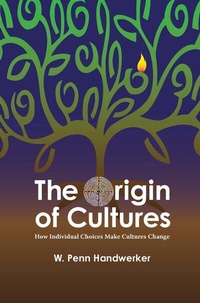
The Origin of Cultures
How Individual Choices Make Cultures Change
1st Edition
Will be published approx. on 15. September 2009
Book
Hardback
155 pages
978-1-59874-067-7 (ISBN)
Description
What makes a 17-year-old girl decide to wrap a bomb around her body, walk into a supermarket, and detonate it, killing herself and an 18-year old girl shopping there? In this provocative and important book, renowned anthropologist W. Penn Handwerker shows that individual choices, from the fatal to the mundane, are fundamentally questions of culture-what it is, where it comes from, and the complex ways it changes and evolves. In accessible and engaging prose, he walks readers through the process of how the human imagination produces new things, shaped by culture and experience but also constantly evolving in unpredictable ways. He shows how understanding cultural dynamics, which explain one girl's decision to murder and another girl's decision to shop, will help us address critical policy questions, from reducing the likelihood of terrorist attacks to responding to global epidemics and addressing climate change.
More details
Series
Language
English
Place of publication
Walnut Creek
United States
Target group
College/higher education
Professional and scholarly
Illustrations
references, index
Dimensions
Height: 229 mm
Width: 152 mm
Weight
362 gr
ISBN-13
978-1-59874-067-7 (9781598740677)
Copyright in bibliographic data and cover images is held by Nielsen Book Services Limited or by the publishers or by their respective licensors: all rights reserved.
Schweitzer Classification
Other editions
Additional editions
E-Book
07/2016
Routledge
€53.99
Available for download
E-Book
07/2016
Routledge
€53.99
Available for download

Book
09/2009
1st Edition
Left Coast Press Inc
€60.60
Shipment within 3-4 weeks
Person
W. Penn Handwerker (Ph.D., Oregon, 1971), Professor of Anthropology at the University of Connecticut, trained as a general anthropologist with an emphasis on the intersection of biological and cultural anthropology, and has published in all five fields (applied, archaeology, biological, cultural, and linguistics) of anthropology. He conducted field research in West Africa (Liberia), the West Indies (Barbados, Antigua, and St. Lucia), the Russian Far East, and various portions of the contemporary United States (Oregon, California's North Coast, Connecticut, and Alaska). He developed new methods with which to study cultures while he studied topics that included the causes and consequences of entrepreneurship, corruption, human fertility, and both inter- and intra-generational power differences. His current research focuses on the possibility that the most effective collective action for community sustainability reflects the cultural assumption that each person knows what's best for him or herself.
Content
Chapter One The Puzzle; Chapter Two What Makes a Door?; Chapter Three Sensory Fields and Cultural Outputs; Chapter 4 Why We Don't Learn What We Could; Chapter Five Consequences Depend on the Distribution of Power; Chapter Six Lessons Learned;