

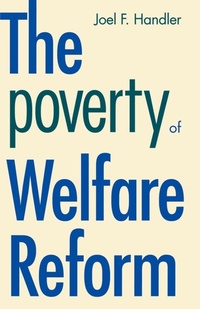
The Poverty of Welfare Reform
Will be published approx. on 12. October 1995
Book
Paperback/Softback
192 pages
978-0-300-06481-0 (ISBN)
Description
Once again, America is getting tough on welfare. Democrats and Republicans at both the national and state levels seem to have agreed that paying public funds to the poor-particularly to single mothers and their children-perpetuates dependency and undermines self-sufficiency and the work ethic.
In this book Joel Handler, a national expert on welfare, points out the fallacies in the current proposals for welfare reform, arguing that they merely recycle old remedies that have not worked. He analyzes the prejudice that has historically existed against "the undeserving poor" and shows that the stereotype of the inner-city woman of color who has children in order to stay on welfare is untrue. Most welfare mothers are in the labor market, says Handler; however, the work that is available to them is most often low-wage, part-time employment with no benefits. Efforts to move large numbers of welfare recipients to full-time employment are not likely to be successful, especially since most of the welfare programs for single mothers are at the state and local levels, and these governments are reluctant to spend the extra money needed to institute work or other reform programs. Handler suggests that national reform efforts should focus less on welfare and blaming the victim and more on increasing labor markets and reducing poverty through legislation that promotes, for example, the Earned Income Tax Credit and universal health care benefits. Welfare reform, by itself, does nothing to improve the job market, and unless there are more jobs paying more income, we will have done nothing to lessen poverty or reduce welfare.
In this book Joel Handler, a national expert on welfare, points out the fallacies in the current proposals for welfare reform, arguing that they merely recycle old remedies that have not worked. He analyzes the prejudice that has historically existed against "the undeserving poor" and shows that the stereotype of the inner-city woman of color who has children in order to stay on welfare is untrue. Most welfare mothers are in the labor market, says Handler; however, the work that is available to them is most often low-wage, part-time employment with no benefits. Efforts to move large numbers of welfare recipients to full-time employment are not likely to be successful, especially since most of the welfare programs for single mothers are at the state and local levels, and these governments are reluctant to spend the extra money needed to institute work or other reform programs. Handler suggests that national reform efforts should focus less on welfare and blaming the victim and more on increasing labor markets and reducing poverty through legislation that promotes, for example, the Earned Income Tax Credit and universal health care benefits. Welfare reform, by itself, does nothing to improve the job market, and unless there are more jobs paying more income, we will have done nothing to lessen poverty or reduce welfare.
More details
Series
Language
English
Place of publication
United States
Target group
College/higher education
Professional and scholarly
Product notice
Paperback (trade)
Dimensions
Height: 21 mm
Width: 14 mm
Thickness: 2 mm
Weight
240 gr
ISBN-13
978-0-300-06481-0 (9780300064810)
Copyright in bibliographic data and cover images is held by Nielsen Book Services Limited or by the publishers or by their respective licensors: all rights reserved.
Schweitzer Classification