

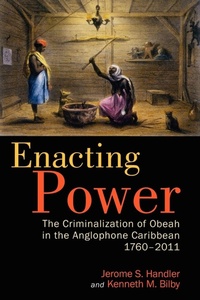
Enacting Power
The Criminalization of Obeah in the Anglophone Caribbean, 1760-2011
Published on 8. November 2012
Book
Paperback/Softback
192 pages
978-976-640-315-7 (ISBN)
Description
More than two and a half centuries after it was first outlawed in Jamaica in 1760, obeah remains illegal in most territories of the former British West Indies. Yet, opinions on the meaning and essential nature of this controversial Afro-Caribbean spiritual phenomenon vary widely. While many contemporary West Indians hold negative views of obeah, viewing it as evil witchcraft or sorcery, others point to its widespread use in healing, protection from harm and solving a wide range of everyday problems - positive views that were also commonly held by enslaved West Indians in earlier generations.
Despite the scholarly attention obeah has received, relatively little has been written about the many laws enacted against it in different territories at different periods. Offering a perspective on obeah that challenges conventional conceptions of this widely misunderstood aspect of West Indian society and culture, the core of this book is a detailed examination of anti-obeah laws, and their socio-political implications, in seventeen jurisdictions of the English-speaking Caribbean from the period of slavery to the present.
Aside from chronologically tracing in each territory the development of these laws and their major provisions, the book also examines how anti-obeah legislation has helped to create and perpetuate cultural distortions that resound into the present. Anti-obeah legislation, particularly after the end of slavery in the nineteenth century, played a central role in creating public misunderstandings of the meaning and role of obeah among the West Indian masses, and led to the stigmatization and devaluation among future generations of African-derived spiritual beliefs and practices.
Despite the scholarly attention obeah has received, relatively little has been written about the many laws enacted against it in different territories at different periods. Offering a perspective on obeah that challenges conventional conceptions of this widely misunderstood aspect of West Indian society and culture, the core of this book is a detailed examination of anti-obeah laws, and their socio-political implications, in seventeen jurisdictions of the English-speaking Caribbean from the period of slavery to the present.
Aside from chronologically tracing in each territory the development of these laws and their major provisions, the book also examines how anti-obeah legislation has helped to create and perpetuate cultural distortions that resound into the present. Anti-obeah legislation, particularly after the end of slavery in the nineteenth century, played a central role in creating public misunderstandings of the meaning and role of obeah among the West Indian masses, and led to the stigmatization and devaluation among future generations of African-derived spiritual beliefs and practices.
More details
Language
English
Place of publication
Kingston
Jamaica
Dimensions
Height: 229 mm
Width: 152 mm
Thickness: 11 mm
Weight
282 gr
ISBN-13
978-976-640-315-7 (9789766403157)
Copyright in bibliographic data and cover images is held by Nielsen Book Services Limited or by the publishers or by their respective licensors: all rights reserved.
Schweitzer Classification
Persons
Jerome S. Handler is Professor Emeritus of Anthropology and Black American Studies, Southern Illinois University, Carbondale, Illinois, and Senior Scholar, Virginia Foundation for the Humanities, Charlottesville, Virginia. His publications include The Unappropriated People: Freedmen in the Slave Society of Barbados and Plantation Slavery in Barbados: An Archaeological and Historical Investigation (co-authored with Frederick W. Lange).
Kenneth M. Bilby is Research Associate, Department of Anthropology, Smithsonian Institution, Washington, DC. He has published numerous articles on Caribbean ethnography and ethnomusicology and is the author of True-Born Maroons.
Kenneth M. Bilby is Research Associate, Department of Anthropology, Smithsonian Institution, Washington, DC. He has published numerous articles on Caribbean ethnography and ethnomusicology and is the author of True-Born Maroons.