

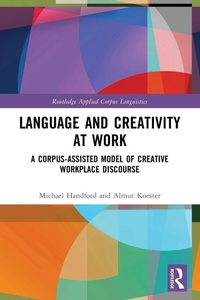
Language and Creativity at Work
A Corpus-Assisted Model of Creative Workplace Discourse
1st Edition
Published on 30. July 2025
Book
Paperback/Softback
200 pages
978-1-032-72648-9 (ISBN)
Description
Language and Creativity at Work: A Corpus-Assisted Model of Creative Workplace Discourse explores linguistic creativity at work as well as the role of language in creative processes in the workplace. Using a mixed-methods approach involving corpus linguistics and discourse analysis, this book:
Provides a critical comparison of previous studies in language and creativity in a linguistic context as well as in the context of businesses and entrepreneurship, and considers the insights that can be gained from both approaches
Argues the case for workplace creativity as a linguistic and discursive phenomenon in addition to a cognitive or relational one
Presents a model of creative workplace discourse that integrates creative language, the creative actions involving language, and alignment between speakers
Employs spoken corpus data from a range of workplace contexts recorded over a 20-year period;
Examines professional practice and creativity in two different professional contexts: a residential care home and a small start-up company, and explores the roles of constraints, leadership and alignment in these contexts
Critically interrogates the notion of creativity as an inherently positive phenomenon and analyses instances of problematic creativity in the workplace
Demonstrates how corpora can be used to underscore assessments of creativity and its realisations in real dialogic contexts.
This book fills an important gap in the literature on creativity within both language and organisational studies, and as such will be key reading for students and researchers of English language, applied linguistics, communication studies and business management.
Provides a critical comparison of previous studies in language and creativity in a linguistic context as well as in the context of businesses and entrepreneurship, and considers the insights that can be gained from both approaches
Argues the case for workplace creativity as a linguistic and discursive phenomenon in addition to a cognitive or relational one
Presents a model of creative workplace discourse that integrates creative language, the creative actions involving language, and alignment between speakers
Employs spoken corpus data from a range of workplace contexts recorded over a 20-year period;
Examines professional practice and creativity in two different professional contexts: a residential care home and a small start-up company, and explores the roles of constraints, leadership and alignment in these contexts
Critically interrogates the notion of creativity as an inherently positive phenomenon and analyses instances of problematic creativity in the workplace
Demonstrates how corpora can be used to underscore assessments of creativity and its realisations in real dialogic contexts.
This book fills an important gap in the literature on creativity within both language and organisational studies, and as such will be key reading for students and researchers of English language, applied linguistics, communication studies and business management.
More details
Series
Language
English
Place of publication
London
United Kingdom
Publishing group
Taylor & Francis Ltd
Target group
College/higher education
Postgraduate
Illustrations
14 s/w Tabellen, 10 s/w Abbildungen, 1 s/w Photographie bzw. Rasterbild, 9 s/w Zeichnungen
14 Tables, black and white; 9 Line drawings, black and white; 1 Halftones, black and white; 10 Illustrations, black and white
Dimensions
Height: 234 mm
Width: 156 mm
Thickness: 12 mm
Weight
339 gr
ISBN-13
978-1-032-72648-9 (9781032726489)
Copyright in bibliographic data and cover images is held by Nielsen Book Services Limited or by the publishers or by their respective licensors: all rights reserved.
Schweitzer Classification
Other editions
Additional editions
Michael Handford | Almut Koester
Language and Creativity at Work
A Corpus-Assisted Model of Creative Workplace Discourse
Book
03/2024
1st Edition
Routledge
€206.20
Shipment within 15-20 days
Michael Handford | Almut Koester
Language and Creativity at Work
A Corpus-Assisted Model of Creative Workplace Discourse
E-Book
03/2024
1st Edition
Taylor & Francis
€60.49
Available for download
Michael Handford | Almut Koester
Language and Creativity at Work
A Corpus-Assisted Model of Creative Workplace Discourse
E-Book
03/2024
1st Edition
Taylor & Francis
€60.49
Available for download
Persons
Michael Handford is Professor of English Language and Applied Linguistics at Cardiff University, Wales.
Almut Koester is Professor of English Business Communication at the Vienna University of Economics and Business, Austria.
Almut Koester is Professor of English Business Communication at the Vienna University of Economics and Business, Austria.
Content
List of illustrations
Acknowledgements
Acronyms and abbreviations
Notes on data and transcription
Introduction
Orientation and Contribution
Chapter Overview
Chapter 1: Language, Discourse and Creativity
1.1 Introduction
1.2 Defining Creativity
1.3 Context and Creativity
1.4 Defining Creativity from an Organisational Perspective
1.5 Language, Discourse and Creativity
1.5.1 Linguistic creativity
1.5.2 Discursive creativity
1.5.3 Linguistic creativity as 'Straw Man'?
1.6 Constraints and Practices
1.7 Conclusion
Chapter 2: Model and Methodology
2.1 Model of Creative Workplace Discourse
2.1.1 The dimensions of the model
2.1.2 Application of the model
2.2 Methodology
2.2.1 The data
2.2.2 Methods: Corpus-assisted discourse analysis
2.2.3 Analysing linguistic creativity: Using frequency-based corpus tools
2.2.4 Analysing discursive creativity: selected methods
2.3 Conclusion
Chapter 3: Language, Creativity and Problem-Solving
3.1 Introduction
3.2 Metaphors and Idioms (MIDs)
3.2.1 Metaphors and idioms in problem-solving
3.2.2 Applying the creative workplace discourse model
3.3 Hypothesising
3.3.1 Hypothetical reported speech
3.3.2 Hypothetical talk
3.3.3 Applying the creative workplace discourse model
3.4 Discussion
3.5 Conclusion
Chapter 4: Creativity and Professional Practice I: Alignment and constraints in a care home
4.1 Introduction
4.2 Exploring Care Home Discourse and Creativity
4.3 Care Home Discourse
4.3.1 Frequency word list findings
4.3.2 Keyword list findings
4.4 What about Creativity?
4.4.1 Metaphors, euphemisms and colloquial expressions
4.4.2 Terms of endearment
4.4.3 Evaluative expressions
4.4.4 Infrequent words
4.5 Discussion and conclusion
Chapter 5: Creativity and Professional Practice II: Innovation and constraints in a start-up
5.1 Introduction
5.2 Interview with CEO: Talking about Innovation and Creativity
5.2.1 Thematic analysis of the interview
5.2.2 Linguistic creativity in the interview
5.3 Meetings: Doing Innovation and Creativity
5.3.1 Weekly meeting of heads of division
5.3.2 Quick performance review meeting
5.4 Discussion and Conclusion
5.5 Comparison of the Care Home and the Start-up
Chapter 6: Problematic Creativity
6.1 Introduction
6.2 Problematic Creativity and Context
6.3 Conflict and Problematic Creativity
6.3.1 Task conflict, an example: Internet server provider meeting
6.4 Humour and Problematic Creativity
6.5 Stereotypes and Problematic Creativity
6.6 Problematic Creativity: Conflict, Humour and Stereotypes in Action
6.7 Conclusion
Chapter 7: Conclusions and Reflections
7.1 What were the Overarching Themes, and what were the Findings?
Theme 1: Appropriate methods for analysing creativity
Theme 2: Problem-solving as a key site for creativity at work
Theme 3: Role of constraints for creativity
Theme 4: Role of the Community of Practice
Theme 5: Creativity as positive or negative
7.2. What has our Creative Workplace Discourse Model Told us about Creativity?
Question 1: Does a high level of linguistic creativity co-occur with a high degree of alignment?
Question 2: If such correlation occurs, does this suggest some underlying causal factor?
Question 3: Do high linguistic creativity and high alignment enable discursive creativity?
Question 4: Does a change in alignment from low to high lead to greater discursive creativity?
7.3 How can Organisations Boost Creativity and Manage it Effectively?
7.3.1 Language matters
7.3.2 Processes of group creativity
7.3.3 The Role of leadership
7.3.4 Diversity and creativity
Appendix
References
Index
Acknowledgements
Acronyms and abbreviations
Notes on data and transcription
Introduction
Orientation and Contribution
Chapter Overview
Chapter 1: Language, Discourse and Creativity
1.1 Introduction
1.2 Defining Creativity
1.3 Context and Creativity
1.4 Defining Creativity from an Organisational Perspective
1.5 Language, Discourse and Creativity
1.5.1 Linguistic creativity
1.5.2 Discursive creativity
1.5.3 Linguistic creativity as 'Straw Man'?
1.6 Constraints and Practices
1.7 Conclusion
Chapter 2: Model and Methodology
2.1 Model of Creative Workplace Discourse
2.1.1 The dimensions of the model
2.1.2 Application of the model
2.2 Methodology
2.2.1 The data
2.2.2 Methods: Corpus-assisted discourse analysis
2.2.3 Analysing linguistic creativity: Using frequency-based corpus tools
2.2.4 Analysing discursive creativity: selected methods
2.3 Conclusion
Chapter 3: Language, Creativity and Problem-Solving
3.1 Introduction
3.2 Metaphors and Idioms (MIDs)
3.2.1 Metaphors and idioms in problem-solving
3.2.2 Applying the creative workplace discourse model
3.3 Hypothesising
3.3.1 Hypothetical reported speech
3.3.2 Hypothetical talk
3.3.3 Applying the creative workplace discourse model
3.4 Discussion
3.5 Conclusion
Chapter 4: Creativity and Professional Practice I: Alignment and constraints in a care home
4.1 Introduction
4.2 Exploring Care Home Discourse and Creativity
4.3 Care Home Discourse
4.3.1 Frequency word list findings
4.3.2 Keyword list findings
4.4 What about Creativity?
4.4.1 Metaphors, euphemisms and colloquial expressions
4.4.2 Terms of endearment
4.4.3 Evaluative expressions
4.4.4 Infrequent words
4.5 Discussion and conclusion
Chapter 5: Creativity and Professional Practice II: Innovation and constraints in a start-up
5.1 Introduction
5.2 Interview with CEO: Talking about Innovation and Creativity
5.2.1 Thematic analysis of the interview
5.2.2 Linguistic creativity in the interview
5.3 Meetings: Doing Innovation and Creativity
5.3.1 Weekly meeting of heads of division
5.3.2 Quick performance review meeting
5.4 Discussion and Conclusion
5.5 Comparison of the Care Home and the Start-up
Chapter 6: Problematic Creativity
6.1 Introduction
6.2 Problematic Creativity and Context
6.3 Conflict and Problematic Creativity
6.3.1 Task conflict, an example: Internet server provider meeting
6.4 Humour and Problematic Creativity
6.5 Stereotypes and Problematic Creativity
6.6 Problematic Creativity: Conflict, Humour and Stereotypes in Action
6.7 Conclusion
Chapter 7: Conclusions and Reflections
7.1 What were the Overarching Themes, and what were the Findings?
Theme 1: Appropriate methods for analysing creativity
Theme 2: Problem-solving as a key site for creativity at work
Theme 3: Role of constraints for creativity
Theme 4: Role of the Community of Practice
Theme 5: Creativity as positive or negative
7.2. What has our Creative Workplace Discourse Model Told us about Creativity?
Question 1: Does a high level of linguistic creativity co-occur with a high degree of alignment?
Question 2: If such correlation occurs, does this suggest some underlying causal factor?
Question 3: Do high linguistic creativity and high alignment enable discursive creativity?
Question 4: Does a change in alignment from low to high lead to greater discursive creativity?
7.3 How can Organisations Boost Creativity and Manage it Effectively?
7.3.1 Language matters
7.3.2 Processes of group creativity
7.3.3 The Role of leadership
7.3.4 Diversity and creativity
Appendix
References
Index