

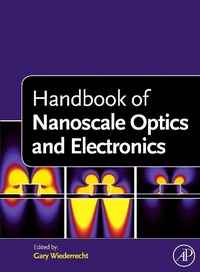
Handbook of Nanoscale Optics and Electronics
Academic Press
Published on 4. November 2009
Book
Hardback
560 pages
978-0-12-375178-2 (ISBN)
Description
With the increasing demand for smaller, faster, and more highly integrated optical and electronic devices, as well as extremely sensitive detectors for biomedical and environmental applications, a field called nano-optics or nano-photonics/electronics is emerging - studying the many promising optical properties of nanostructures. Like nanotechnology itself, it is a rapidly evolving and changing field - but because of strong research activity in optical communication and related devices, combined with the intensive work on nanotechnology, nano-optics is shaping up fast to be a field with a promising future. This book serves as a one-stop review of modern nano-optical/photonic and nano-electronic techniques, applications, and developments.
More details
Language
English
Place of publication
San Diego
United States
Publishing group
Elsevier Science Publishing Co Inc
Target group
Professional and scholarly
Materials scientists, chemists, physicists, (telecommunications, computer) engineers, surface and physical chemists, advanced undergraduate and graduate students in electrical and electronic engineering, nanoscience, materials, bioengineering and chemical engineering.
Product notice
sewn/stitched
Cloth over boards
Dimensions
Height: 270 mm
Width: 200 mm
Thickness: 25 mm
Weight
1140 gr
ISBN-13
978-0-12-375178-2 (9780123751782)
Copyright in bibliographic data and cover images is held by Nielsen Book Services Limited or by the publishers or by their respective licensors: all rights reserved.
Schweitzer Classification
Other editions
Additional editions
Jiju Antony | Gary Wiederrecht
Handbook of Nanoscale Optics and Electronics
E-Book
05/2014
Academic Press
€175.00
Available for download
Person
Gary Wiederrecht is the Group Leader of the Nanophotonics Group in the Center for Nanoscale Materials at Argonne National Laboratory. His research interests center on the photochemistry and photophysics of nanoparticles and periodic assemblies, hybrid nanostructures, photochemical energy conversion, and non-linear optical responses resulting from photoinduced charge separation. His experimental expertise is in the areas of ultrafast optical spectroscopy and scanning probe microscopy, including near-field scanning optical microscopy. He has received an R&D100 award, the Department of Energy Young Scientist Award, and the Presidential Early Career Award for Scientists and Engineers. He has authored or co-authored approximately 80 peer-reviewed research articles, and works collaboratively with scientists around the world. He enjoys traveling, nature, and spending time with his family.Chemist, Group Leader, Nanophotonics GroupArgonne National Laboratory Chemistry Division, E1619700 South Cass AvenueArgonne, IL 60439-4831
Content
1. Metallic nanostructures and plasmonics
2. Surface nanophotonics theory
3. Nanohole arrays
4. Photonic crystals - theory
5. Photonic crystals - experimental
6. Metamaterials
7. Thin film quantum wells
8. Surface enhanced Raman spectroscopy
9. Organic LEDs
10. Evanescent plasmonic sensors
11. Nanoscience for energy (quantum dot solar cells)
12. Optical holograghic data storage
13. Super-RENS optical near-field methods
14. Nanoelectronic devices
15. Spintronics
16. Molecular devices
17. Nanoscale transistors
18. Nano-CMOS
2. Surface nanophotonics theory
3. Nanohole arrays
4. Photonic crystals - theory
5. Photonic crystals - experimental
6. Metamaterials
7. Thin film quantum wells
8. Surface enhanced Raman spectroscopy
9. Organic LEDs
10. Evanescent plasmonic sensors
11. Nanoscience for energy (quantum dot solar cells)
12. Optical holograghic data storage
13. Super-RENS optical near-field methods
14. Nanoelectronic devices
15. Spintronics
16. Molecular devices
17. Nanoscale transistors
18. Nano-CMOS