

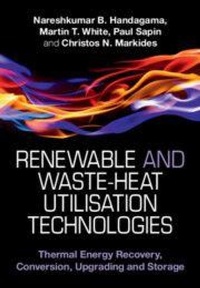
Renewable and Waste-Heat Utilisation Technologies
Published on 1. June 2023
Book
Hardback
218 pages
978-1-108-48077-2 (ISBN)
Description
Understand the science and engineering behind conventional and renewable heat loss recovery techniques with this thorough reference. Provides you with the knowledge and tools necessary to assess the potential waste-heat recovery opportunities that exist within various industries and select the most suitable technology. In particular, technologies that convert waste heat into electricity, cooling or high-temperature heating are discussed in detail, alongside more conventional technologies that directly or indirectly recirculate heat back into the production process. Essential reading for professionals in chemical, manufacturing, mechanical and processing engineering who have an interest in energy conservation and waste heat recovery.
Reviews / Votes
'... a good review of waste-heat recovery technology, including the conversion of waste heat into electricity and heat recirculation into the production process. ... scholars pursuing research in areas related to conventional and renewable heat-loss recovery will find it a good resource. ... Recommended.' R. N. Laoulache, ChoiceMore details
Language
English
Place of publication
Cambridge
United Kingdom
Product notice
sewn/stitched
Cloth over boards
Illustrations
Worked examples or Exercises
Dimensions
Height: 244 mm
Width: 170 mm
Thickness: 14 mm
Weight
549 gr
ISBN-13
978-1-108-48077-2 (9781108480772)
Copyright in bibliographic data and cover images is held by Nielsen Book Services Limited or by the publishers or by their respective licensors: all rights reserved.
Schweitzer Classification
Other editions
Additional editions
Nareshkumar B. Handagama | Martin T. White | Paul Sapin
Renewable and Waste-Heat Utilisation Technologies
E-Book
05/2023
Cambridge University Press
€119.99
Available for download
Persons
Nareshkumar B. Handagama is a chemical engineer with more than thirty-five years of research & development and industrial experience in some of the world's largest public and private utilities, chemical, and petrochemical companies. Currently, he is the Chief Operating Officer at Sri Lanka Nano and Advanced Technology Centre (SLINTEC). He is a licensed Professional Engineer (PE) in the USA, and a Charted Engineer in the UK, Fellow of the American Institute of Chemical Engineers (FAIChE) and a Fellow of the Institution of Chemical Engineering (FIChemE. London, UK).
Content
1. Introduction; 2. Heat-recovery fundamentals; 3. Heat conversion and upgrading technologies; 4. Technology-agnostic modelling; 5. Rankine cycles; 6. Heat pumps and chillers; 7. Application of heat conversion and upgrading technologies; 8. Thermal energy storage; Appendix A. Commercial systems.