

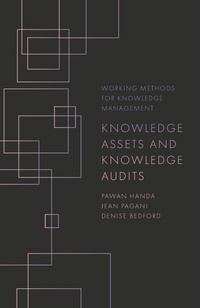
Knowledge Assets and Knowledge Audits
Published on 25. October 2019
Book
Paperback/Softback
304 pages
978-1-78973-774-5 (ISBN)
Description
With the rising importance of knowledge as a primary factor in global industries, it is increasingly necessary for knowledge management professionals to understand, engage with, and speak the language of assets, investments and auditing. However, all too often, professionals don't have these skills, and have no way to learn them.
This exciting guide helps knowledge management professionals gain a basic understanding of assets, investments and audits, so they can command respect from those who are in control of financial investments. It also ensures that organizations have a roadmap for developing short- and long-term investment strategies. Providing guidance for identifying assets - and liabilities - as well as describing the types of investment available to align with knowledge assets, expert authors Pawan Handa, Jean Pagani, and Denise Bedford walk readers through standard audit practices, and help you through the process of designing, conducting, and reporting on the results of a knowledge audit.
For knowledge management professionals, corporate and business leaders and managers, workforce professionals, and educators, this is an unmissable guide that unites the new face of the global economy with accepted auditing practices.
This exciting guide helps knowledge management professionals gain a basic understanding of assets, investments and audits, so they can command respect from those who are in control of financial investments. It also ensures that organizations have a roadmap for developing short- and long-term investment strategies. Providing guidance for identifying assets - and liabilities - as well as describing the types of investment available to align with knowledge assets, expert authors Pawan Handa, Jean Pagani, and Denise Bedford walk readers through standard audit practices, and help you through the process of designing, conducting, and reporting on the results of a knowledge audit.
For knowledge management professionals, corporate and business leaders and managers, workforce professionals, and educators, this is an unmissable guide that unites the new face of the global economy with accepted auditing practices.
Reviews / Votes
Taking a project-management approach, Handa, Pagani, and Bedford describe how an organization can prepare for and conduct an audit of its knowledge assets and processes. In addition to identifying tasks and sub-tasks to achieve a reliable, repeatable, and valid audit, they set out criteria for deciding what to audit, how to audit it, and how to interpret and communicate the results. The sections cover auditing knowledge, defining and identifying knowledge assets, managing knowledge assets, and accounting for knowledge assets. Distributed in North America by Turpin Distribution. -- Annotation (c)2019 * (protoview.com) *More details
Series
Language
English
Place of publication
Bingley
United Kingdom
Target group
Professional and scholarly
Dimensions
Height: 198 mm
Width: 129 mm
Thickness: 16 mm
Weight
326 gr
ISBN-13
978-1-78973-774-5 (9781789737745)
Copyright in bibliographic data and cover images is held by Nielsen Book Services Limited or by the publishers or by their respective licensors: all rights reserved.
Schweitzer Classification
Other editions
Additional editions
Pawan Handa | Jean Pagani | Denise Bedford
Knowledge Assets and Knowledge Audits
E-Book
10/2019
1st Edition
Emerald Publishing Limited
€41.99
Available for download
Persons
Pawan Handa, PhD, retired from The Goodyear Tire & Rubber Company after holding several global R&D leadership positions, including strategy development and integration. His last assignment was leading the knowledge management effort. Jean Pagani has spent more than forty years working on issues related to knowledge articulation, sharing and internalization in global corporate, social, and civic spheres. Her work focuses on helping organizations address cultural barriers that challenge their ability to fully realize the potential value of their ideas.
Denise Bedford, PhD, is faculty at Georgetown University, a Visiting Scholar at University of Coventry, and Distinguished Practitioner, U.S. Department of State.
Denise Bedford, PhD, is faculty at Georgetown University, a Visiting Scholar at University of Coventry, and Distinguished Practitioner, U.S. Department of State.
Content
Part I: Knowledge Audits - Models and Methods 1. Audits - What To Audit And Why
2. Audit Methodology For Business Processes
3. Audit Methodology For Knowledge Functions
4. Designing an Audit Of Knowledge Assets
Part II: Defining and Identifying your Knowledge Assets
5. Identifying and Categorizing Organization's Knowledge Assets
6. Identifying Sources and Ownership of Knowledge Capital Assets
7. Define the Useful Business Life of Knowledge Assets
Part III: Managing Knowledge Assets
8. Business Transformation of Knowledge
9. Current Management of Knowledge Assets
10. Managing Risks of Knowledge Assets
11. Define Investment Strategies for Knowledge Assets
Part IV: Accounting for Knowledge Assets
12. Assigning Value to Knowledge Assets
13. Defining the Costs of Knowledge Assets
14. Defining the Revenue and Profit Generated by Knowledge Assets
2. Audit Methodology For Business Processes
3. Audit Methodology For Knowledge Functions
4. Designing an Audit Of Knowledge Assets
Part II: Defining and Identifying your Knowledge Assets
5. Identifying and Categorizing Organization's Knowledge Assets
6. Identifying Sources and Ownership of Knowledge Capital Assets
7. Define the Useful Business Life of Knowledge Assets
Part III: Managing Knowledge Assets
8. Business Transformation of Knowledge
9. Current Management of Knowledge Assets
10. Managing Risks of Knowledge Assets
11. Define Investment Strategies for Knowledge Assets
Part IV: Accounting for Knowledge Assets
12. Assigning Value to Knowledge Assets
13. Defining the Costs of Knowledge Assets
14. Defining the Revenue and Profit Generated by Knowledge Assets